


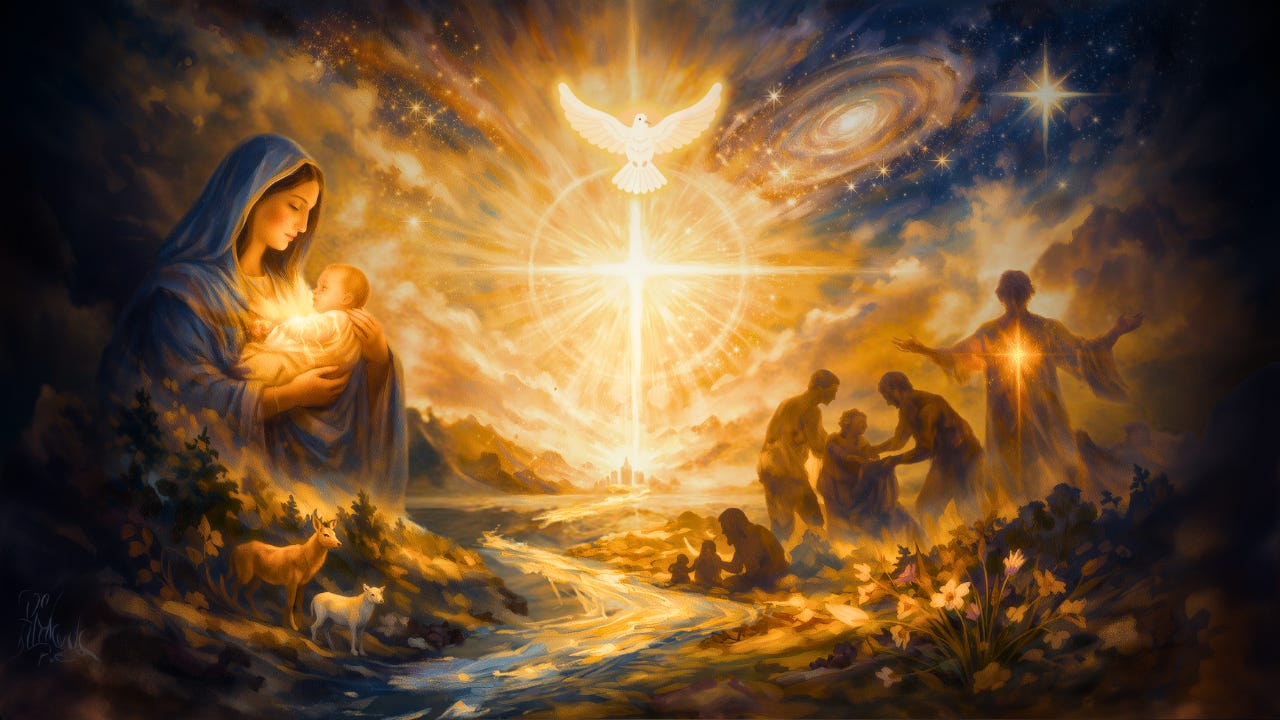
The Threshold of Incarnation
The Incarnation of the Light is not a one-time event locked in history; it is the ongoing revelation of the Cosmic Christ woven through all things. The Divine Word and Light shape reality, not through anything we can weigh or quantify, but in the way they kindle love, compassion, justice, wisdom, and every fruit that brings life to bloom. As we cultivate these gifts within ourselves, we join the creative heartbeat of the cosmos, helping to heal what is broken and letting the sacred Light move through us until the world remembers how to flourish again.
Mary stands at this threshold as our icon and guide. She embodies Original Blessing and reveals that grace, wisdom, and divine presence are stitched into the very fabric of creation. As we look to her as the cosmic mother who consents to birth the Holy into the world, we learn how to participate in that same sacred creativity, letting mercy, justice, and deep compassion take root in us until we become living bearers of the Light, God living through our very flesh.
Creation itself is our first textbook of faith and our oldest sanctuary. Through awe, it teaches us that everything is alive, interconnected, and shimmering with the One Life in which we live, move, and have our being. When we see the world not as a pile of objects but as a web of kin, our choices become living prayers of creativity, justice, and celebration. In that shared practice of wonder and responsibility, we help heal suffering, midwife the world to come, and step more fully into the Gospel of Becoming.
For those of us drawn to the message of Jesus, all of this prepares us to welcome the Cosmic Christ in, with, and through all things so we can co-create the world to come with him to bring the kin-dom to the world.
John 1:9
9. The true light that enlightens everyone was coming into the world.
At the precipice of Christmas, we open ourselves to the Light taking flesh. The Light does not elevate humanity above creation, but illuminates the intricate weave we are woven into.
Christ Who Empties: Kenosis as Divine Solidarity
Philippians 2:5-8
5. Have this in your mind, which was also in Christ Jesus,
6. who, existing in the form of God, didn’t consider equality with God a thing to be grasped,
7. but emptied himself, taking the form of a servant, being made in the likeness of men.
8. And being found in human form, he humbled himself, becoming obedient to death, yes, the death of the cross.
If we are going to live God into the world, then we need to understand what it means to have the same mind in us that was also in Christ Jesus. Jesus was not pretending to be God or claiming to be God but existed in the form of God. In other words, Jesus existed in exactly the same way that God exists. In our tradition, we refer to this as living God. God as a verb.
Rabbi David A. Cooper, God is a Verb, 69
The closest we can come to thinking about God is as a process rather than a being. We can think of it as “be-ing,” as verb rather than noun…Most of our verbs are considered transitive, which require a direct object, or intransitive, which do not. (Rabbi Zalman Schachter-Shalomi) suggests that God-ing is a mutually interactive verb, one which entails an interdependency between two subjects, each being the object for the other.
The mind that we see here in Christ Jesus is one that, while it understands that it is in the form of God, it is constantly pouring itself out, even into the form, the identity of a servant. This is the mind of absolute service. What we are doing in this world is mutually co-creating with it, pouring ourselves out in the form of our living so that it will be remade into the grand world that we desire to see in the world to come.
When we reclaim our identity as people who live God into the world, we are adopting this mindset and acting in this world through our Christhood. We are healers, those who act from a place of awe, wonder, and delight, and who, through spaciousness, openness, and the willingness to let go, utilize our creative acts to birth compassion, and through that compassion to give rise to justice and celebration in the world.
So as we take this time in the womb of the Spirit to await the coming of the Cosmic Christ, we are examining that glory, that Word and Wisdom, that Light and Life that flowed through Him as He took upon Himself the name of God.
Bearing The Name of God
John 1:14
14. The Word became flesh, and lived among us. We saw his glory, such glory as of the one and only Son of the Father, full of grace and truth.
The child of God is the one who bears the name of God within them. This has been an old tradition that we see in the Davidic line of kings. In taking on that most sacred name, one is taking upon themselves all of the grace and truth that flows through it. The name of God is being itself. That being created the world through original grace, in original blessing, with original mind and original wisdom.
When John says, we saw his glory, that glory is the name of God. In the scriptures, we often see this conflation of the glory of God and the name of God. The word here is the tabernacle of the name, and the tabernacle in which we live. This is the dwelling place of the name. When we take on the name of Christ Jesus, we are entering into that tabernacle through the narrow gate so that we too are recognizing our life in God.
That doesn’t mean that this is something exclusive to Christians. This is a state found throughout the cosmos and in every religion and culture. This is how we as Christopagans name this tradition and call it forth inside our lives.
This is the mystery revealed in the High Priestly Prayer of Jesus.
Process of Living God
John 17:6
6. I revealed your name to the people whom you have given me out of the world. They were yours, and you have given them to me. They have kept your word.
Christ reveals to us this name of God by encouraging us to live without anxiety and understanding that the natural flow flows through us, that the same spirit that gives food to the creatures of the field and clothing to the flowers is there with us, reminding us also that it is our duty to make sure that everyone is fed and given water, comfort when they are sick, visited when they are imprisoned, and helped when they are seeking refuge.
We see this mutuality in all of the teachings of Jesus. That we are comforted when we mourn, that we are here to take care of one another and to love our neighbor as ourselves, and how Jesus pairs that commandment with our duty to love God with our heart, mind, and spirit.
This is what it means to see God as a mutually interactive verb and to see our place within it. For in the process of living God, in bringing compassion, justice, awe, wonder, delight, creativity, spaciousness, and celebration into the world, we are channeling the very powers of God into life itself. We recognize that Christ is within us, around us, and flowing through us just as God is in us, around us, and flowing through us. That this energy is omnipresent throughout the cosmos.
Oneness of God
John 17:11
11. I am no more in the world, but these are in the world, and I am coming to you. Holy Father, keep them through your name which you have given me, that they may be one, even as we are.
Jesus prayed that we may be one, even as he was with the Father. That oneness comes not from all agreeing on the same things or all believing the same things. This is not a oneness born out of conformity or doctrinal obedience. No, this is a oneness that comes through our actions as mutually interactive verbs, as people who are coming together to live God into the world.
This is the process of chrismation, of deification, of our becoming Christ to this world, and in so doing, becoming God to this world. Not, as we read before: to puff ourselves up and see that we are higher than others; but to understand that we have this infinite well within us that we can pour out even unto death, a death on a cross, that we can continuously allow that divine flow to work through us for the betterment of ourselves, our communities, and our world to restore and heal it.
Philippians 2:9
9. Therefore God also highly exalted him, and gave to him the name which is above every name;
The name that was given to Christ is the all-holy name, the Tetragrammaton, the name of being itself. It is the name above every name, and it is the name that dwells within us so long as we do not take it up in vain.
Not Taking God’s Name in Vain
How does that work? Well, we’ve seen this process very explicitly put forward in Torah. In Exodus, we see God sending an angel before the people, and they are given a very particular command.
Exodus 23:20-23
20. “Behold, I send an angel before you, to keep you by the way, and to bring you into the place which I have prepared.
21. Pay attention to him, and listen to his voice. Don’t provoke him, for he will not pardon your disobedience, for my name is in him.
22. But if you indeed listen to his voice, and do all that I speak, then I will be an enemy to your enemies, and an adversary to your adversaries.
23. For my angel shall go before you, and bring you in to the Amorite, the Hittite, the Perizzite, the Canaanite, the Hivite, and the Jebusite; and I will cut them off.
This angel carries within the name of God and thus has the powers of God residing within them. This angel can forgive disobedience (sin) and not hold it against people. This angel can work in the world in the person and voice of God. That is living God.
In the same way, the divine name rested upon the angel. The divine name rested within the Rabbi Jesus of Nazareth, a Galilean who spoke to the needs of the people that were being unserved by patriarchy and empire. The same Jesus who told us to work for one another and to bring healing and restoration to the world, to proclaim the jubilee year where debts are forgiven and healing is poured out on the people and the land.
In our humility, we do not take up the name of God but the name of Christ, the one who holds the cosmos together, the one in whom the name lives. We, as living temples, carry within us the ark of the covenant, of this new covenant, that lives within us, bearing the name of God within it. And we need to be careful not to take upon ourselves this name in vain.
Exodus 20:7 (cf. Deuteronomy 5:11)
7. “You shall not take the name of Yahweh your God in vain, for Yahweh will not hold him guiltless who takes his name in vain.
This is one of the most misunderstood commandments of the Ten. It has come to mean that we should not proclaim the name of God in a profane way, in other words, outside of holy or sacred duties. This has led many people to not say the name of God, and some pious Jews don’t even write the word out entirely, even in English. I practice this mitzvah this way: when I say HaShem instead of pronouncing the holy name of God. But that is not what this commandment is referring to.
To take the name of God is to either invoke it as an oath or as a sign of your power and authority. In this way, taking the name of God in order to lie or to trick others into seeing us as more powerful, more high, more worthy of devotion, praise, or gifting, is to take the name of God in vain. Since the name of God resides in Christ, to call oneself a Christian and to do so when not being about the work that we are called in living God, in being this force of compassion in the world, that is taking the name of God in vain. These are examples of violations of this commandment:
To trick people to give their wealth to you so that you can enrich yourself at their expense
To give yourself power in the groveling of others who think that you are somehow superior to them
To elevate yourself or the Christian community above others
To claim that the anointing absolves pastors of all sins
To pretend to heal others when you do not have the power to do so
To refuse to grant forgiveness and mercy
To refuse to care for the stranger, hungry, poor, homeless, or imprisoned among us
To alienate anyone from the love of God
To call injustice, hardheartedness, and the proclamation of lies holy
As those who use the name Christian, we are called to pour out that divinity that is within us, to use it through service and support, to use it to help others as we live God in Christ in the world. That giving of ourselves is not self-negation, but self-giving. It is the love that pours out from us into the world, that love which itself is God.
This is how the infinite enters our finite world. This is how the infinite works in us. It is not about pity, but about kinship. It is how we interrelate to each other in recognizing our own interbeing and mutual existence.
If my neighbor is suffering, how can I expect not to suffer? Ignoring problems does not make them go away. You cannot punish someone out of poverty or out of homelessness or out of hunger or thirst. All you can do is provide them food, water, a place to live, and a way to live in dignity.
The gospel that we live, the life that we are called to, is one of solidarity. God does not stand above creation. God has entered creation and is flowing through all things. God is the One Life within all of us. God becomes creature among creature, woven into the very ecology of breath and dust, of star and storm.
The incarnation began long before that trip to Bethlehem, before Mary even heard the whisper of the angel. The mysteries of Advent began at the first flaring forth. They have always been true. Stars have been born and died so that we could be here. They did not know that we would come. They did not know the certainty of the world before them, and neither do we. They lived their life for the betterment of the cosmos and for the delight of being a star.
This is the mystery of the season that we are entering into. The glorious truth that the cosmos has always been becoming, transforming, and transmuting throughout ages past and into aeons in the future. A new thing is always rising, and we are called to be a part of that great flow and consciously to steer it as best we can towards a good world to come. A precious future world in which all are taken care of, and there is no hunger or thirst or homelessness or need to be a refugee, a world where all are healed. But until we get there, it is our task to ever strive towards it.
Christ Who Fills All Things
Colossians 1:15-17
15. who is the image of the invisible God, the firstborn of all creation.
16. For by him all things were created, in the heavens and on the earth, things visible and things invisible, whether thrones or dominions or principalities or powers; all things have been created through him, and for him.
17. He is before all things, and in him all things are held together.
Christ is the image of the invisible God, meaning the tangible, the touchable face, the thing made in such a way that we have access to it, but within it, it bears the divine name. As divine wisdom, this Christ is the firstborn of all creation, who played with God before the foundations of the earth. And through this cosmic Christ, all things were created in heavens above and on earth below, everything visible and invisible.
That phrase visible and invisible is doing a lot of work here. It is not just about what we can see and what we can’t see. It’s about those things that are beyond our ability to see. Thrones, powers, and dominions have been turned into orders of angels by later Christian mystics and theologians. But they are concepts. They are ideas on how we order our cosmos. They are derived from human intellect and through human work and through human culture.
This is the process of co-creation in action. It is not just the divine Christ, the image of God outside of us, but the very image of God within us that was put in us when we were born, when we were created, when the universe was new. This is the work of the One Life co-creating everything.
The Christ child’s cradle is not just a manger in Bethlehem, or the heart of the believer, but the cosmos itself. The power of the story is not that Christ is an exception, but the pattern. We, like him, share in the Word, the Life, and the Wisdom of God, and through living God into the world, co-create the cosmos. That doesn’t mean that we can say, “Let there be a star,” and a new star is formed. But it does mean we can say collectively, this king shall fall, and that king falls.
History is replete with the collective power of people to change the world for better and for worse. It is the great lie of power to say that a great man, they usually pick a man, was responsible for those changes. They may have been the spearhead, they may have been the mouthpiece of the movement, but without the movement behind them, they never could have succeeded. Even the most tacit acceptance of the authority statements of others is a deed to co-create that thing in our name. That is why we have to be careful to ever be living God and not abdicating our duty to work wonder, awe and delight, justice and spaciousness, celebration and creativity into everything we do.
Unlike how the Platonists and Neoplatonists saw the world, matter is a sacrament, and through its sacramental glory, it brings grace into our lives. When we reject that Greco-Roman layer that was added on top of Christianity, we begin to see this glory of God shining through everything. The cosmos is our actual cathedral, not the stone edifices built through labor. Life, the life of each and every one of us, is the ongoing incarnation of the light and life of God into the world.
As we’re reminded in Psalm 104, the springs run, the winds move, and the creatures sing the song of God. When we learn to sing in unison or in harmony, then great changes come. And I mean great in the way that something is large, not necessarily in the way something could be good.
All that is necessary to change the world is to get enough people to consent to those changes. That mechanism can be used for good or for evil. It is our sacred calling to do everything in our power to ensure that it is used for good.
Christ Who Reconciles: The Restoration Gospel
Colossians 1:20 - WEB
20. and through him to reconcile all things to himself, by him, whether things on the earth, or things in the heavens, having made peace through the blood of his cross.
This powerful conclusion, Paul is saying that through Christ, God acts fully to restore the entire cosmos, drawing all things back into right relationship with God, actively creating peace through the self-giving which absorbs the violent act of the cross.
The sacrifice at the cross is not a sacrifice made to propitiate an angry God. This is not a human sacrifice to pay a cost. Here, we see the cosmic Christ embodied in Jesus, going to his death and not repaying violence for violence. We see the compassion of God played out fully here, that in absorbing all of that hatred, anger, and imperial suffering into himself, the world is restored to peace.
This is framed not only as a symbolic act but as an act that is rooted deep in the being of the universe. As we have discussed, God as an interrelational verb, we can see that interrelation happening here. All of the teachings of Christ are epitomized on the cross. When he receives hatred, he gives back love. When he receives condemnation, he gives back pardon. When he receives death, he gives life. This is the transmutation of evil into good. The very restorative process that exists within each and every one of us.
Tonglen is a Tibetan Buddhist practice of compassion in which a person mindfully breathes in the suffering of others and breathes out relief, love, and healing, not as self punishment but as an act of radical solidarity. The practice trains the heart to stop fleeing pain and instead meet it with openness, allowing compassion to replace fear and separation.
Seen through a Christian lens, the sacrifice of Jesus on the cross can be understood in a similar way. Jesus willingly receives the weight of human violence, shame, and brokenness and responds not with retaliation but with forgiveness, mercy, and restored relationship. In both Tonglen and the cross, suffering is not denied or bypassed but taken into oneself and transformed through love, revealing a way of being in the world where compassion absorbs harm and gives life back in return.
This is how we bring reconciliation to the world. We see and acknowledge the true suffering that exists within it and do what is within our power to alleviate it, relieve it, and bring peace. Our work is about restoration, restorative healing, restorative justice, restorative compassion, and restorative care. We are here to bring restoration both between the human and the divine, between the human and the earth, and between humans and each other. But more than anything, we are here to bring restoration between our soul and its own depths.
When we deny our own ability to give to the world, or restrict people from giving to the world, then we are shutting off key aspects of who we are as people. All of us experience awe and wonder, spaciousness, creativity, a desire for justice, and celebration. When we close those off to ourselves and others, then we are doing harm to the life of the world.
We cannot shield ourselves from the pain that others experience. We have to engage with it and find ways to alleviate it. Ways to bring down the greed, the hunger for power, and the fear of others that makes that suffering so much worse and often causes that suffering in the first place.
Christ Who Indwells: Incarnation as a Shared Vocation
Colossians 1:27
27. to whom God was pleased to make known what are the riches of the glory of this mystery among the Gentiles, which is Christ in you, the hope of glory;
As soon as we can realize that the message of the cross and the message of Advent are not about the Christ out there, but the Christ within us. That Christ in us is the hope of glory, that Christ is always in us, in each and every one of us, though some try to chain or imprison that Christ. Once we realize that Christ can be set free and that we can learn to live in the divine flow with Christ within us, around us, and flowing through us, we can take our place in the world.
This is not a path that is exclusive to Christians, but this is the path that Christ calls us to. We are not called to a theology or to a belief system, but to a system of transformation of ourselves, of our families, of our communities, and of the entire cosmos. We are called to free that Christ energy within us and let it flow through us to co-create the world.
Incarnation is not something that happened 2000 years ago, it is something that is happening now. Not just in this season, but in every moment of the world. Every time a child is born, Christ is born in this world. Every time love is born in someone’s heart, Christ is born in this world. Every time justice is done in this world, Christ is born in this world. In every act of creativity and wonder and celebration, Christ is born in this world. When we make space for our differences and a place to acknowledge suffering, Christ is born in this world.
The Light, the Word, it all became flesh, not just in a rabbi 2,000 years ago, but in us. This life was the light of all humanity, the Gospel tells us. This light is the life of all humanity, the Gospel tells us. It is the light within us yearning to breathe free.
When we allow ourselves to become bearers of the word, carriers of the light, and participants in the divine becoming, or to say it another way, we are agents of transformation in this world. Our lives are renewed from the inside out.
Like Mary, all we have to do is accept the invitation and say yes. Our Divine Mother is the heart beating within us, that original grace, that original blessing calling us forward. In her womb, our hearts are formed. Her fidelity is our path. In her grace, we find the Christ child within us and have the courage to raise that spirit and give it life in the world anew.
Kenosis as Our Path: Emptying as Hospitality to Love
Philippians 2:5
5. Have this in your mind, which was also in Christ Jesus,
This is the way we walk the path. It is continual self-emptying, but not ascetic self-emptying. We’re not denying ourselves. We are not denying our pleasures. We’re not denying the world. We are opening ourselves enough that we can empty ourselves of fear, not self. We are emptying domination, not dignity. We are releasing falsehood, not our voice. We’re doing all of this so that love, wisdom, truth, and justice can flourish within us and flow through us out into the world.
We empty ourselves because we know the flow of life is flowing in us and that we will always be refilled.
Isaiah 40:31
31. But those who wait for Yahweh will renew their strength. They will mount up with wings like eagles. They will run, and not be weary. They will walk, and not faint.
We are not passively waiting for God. We are actively engaging that deep strength within us that comes from the One Life. We are living our Christhood into the world. We are living God into the world. We are breaking the chains that have been put on us by the power hungry, the greedy, and the fearful, so that we can erase the mask that they have placed over us, or even the mask our own egos have built before us so that our light can shine forth.
Christ is in you, the hope of glory. Christ is in me, the hope of glory. Christ is in us, the hope of glory. Glory. Glory can be ours. The world can be made anew. Restoration can come, but we must first have patience and strength.
Becoming Light-Bearers in a Shadowed World
Open your heart to that light, that hope of glory deep within us. Allow that love, peace, and joy to flow through you. This is not a one-time name-it-and-claim-it kind of prayer. It is an invitation to an inner awakening, not to receive salvation from outside but from within. We don’t have to wait for another person to liberate us. Liberation begins as a state of mind, and through collective action becomes real, manifested into the world.
Open yourself up to that one true light shining within you. The same light that shone forth when the cosmos was new. That font of original grace, original blessing, that place where all things are made new. The word resonates in our very bones. Even without our knowing it, we collaborate with the cosmos for everything that we have become and will become. All you have to do is recognize it.
The seed of the Tree of Life is within each and every one of us. All we must do is tend and water it so that it can grow. We do that through a life of awe, silence, spaciousness, creativity, justice, and celebration. Seek out the steps that bring you these things. Delight in what you find. That delight is the light that shines on the tree and makes it strong so that our life flows ever more brilliant from us.
Light of All Creation
Blessed light of all creation that shone forth at the beginning. The one who shaped the cosmos and gave it form in wisdom and in delight. Open our eyes so that we might see.
Help us to have the same mind in us that was also in Christ Jesus, that we can live God into the world, ever emptying ourselves out since we know the font of all life flows within us and through us.
Teach us to reconcile all things to each other, to ourselves, and to the cosmos. May we leave peace, love, and joy in our wake as we ever work for equity, justice, and right relationship.
O most holy light that indwells and illuminates all things, grant us the ability to see where we can be of use and where we can take refuge. Help us to proclaim the acceptable year of the Lord, where justice flows like water and everyone is taken care of.
Give us ears to hear so that we may ever listen to the words flowing from the mouth of God. Life, joy, awe, silence, openness.
Give us eyes to see the light shining in all things, from the stars in the heavens above to the rocks beneath our feet, in the rivers and in the trees, and in the faces of everyone we meet, no matter how much they may have clouded it or barred it away from the world.
As the Divine Mother bears us in the image of her Son, help us to usher that life into the world. Teach us to live Christ, to live God to everyone that we meet, so that in our words and in our actions and in our thoughts all there is is life, love, and compassion in abundance.
The song of creation is the great peace beyond all understanding. Part moving with part, whole moving with whole, together in one great dance throughout the cosmos. Help us to sing the song.
Awaken our hearts so that we may become one with Christ, for he is the all in all. He is the thread of the great tapestry of life, and the light by which we see it. The gentle wind that causes it to move, and the word that it constantly speaks.
In awe, may we delight in the glories of God. In open silence, may we sit with what we do not understand and what causes pain. In creativity, may we dance, giving birth to God, who is our Mother. In justice, may we ever celebrate, knowing our part that we have played in it and will continue to play until all the world is restored to the great vision of unity and peace.
Amen.