


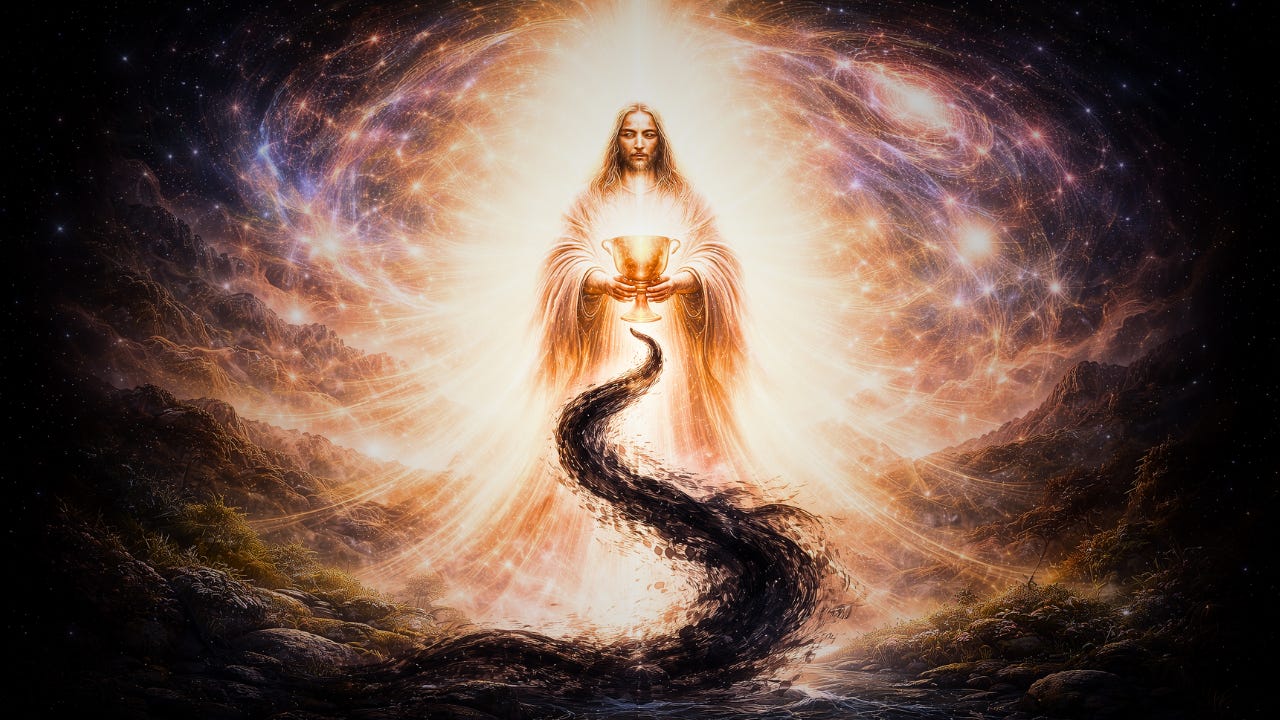
John is an interesting figure where myth, metaphor, and reality do a dance.
There were those in the early church who claimed to have been taught by him, lending credibility to the idea that there was a historical John. Yet stories of him persist in ways that make him something more than a historical figure limited to a particular time. John was an apostle, possibly even the beloved disciple. He was one of the sons of Zebedee and the brother of James. John is also the name of a lineage, a collective tradition within the faith that brought us the epistles and the gospel that bear his name.
John was in the inner circle, one of three disciples brought in close to Christ to be with him when he prayed. He is also a mystic figure who has appeared in visions throughout Church history to guide and teach those who sought wisdom and understanding. There were early Christians who claimed to have been taught by him directly, and there were later saints and poets who encountered him not as a memory but as a presence.
What if I were to invite you into a world where John is the mystic who walks between the worlds, someone to whom Christ promised he would not die until he saw the kin-dom of God on earth (Mark 9:1)? What if John is an inhabitant of the other world, where the spirits live, fully alive and engaged with the life of the believer? What if he is not confined to a single century but moves calmly in the shimmering in-between?
What if I told you that John is the apostle of love we encounter when we speak about love and live in a way of love? What if he is the guide who helps us see the Word, the Light, and the Life in all of creation, helping us to perceive the deep pattern woven through the world?
John is not something or someone we are required to believe in. John is the embodiment of a relationship we have with the divine, and the one through whom we can encounter that holy life that lives in all things.
The Sons of Thunder
John and James are described as being the sons of Zebedee, which we are told means sons of thunder. We can see this energetic zeal throughout the stories, where John is always excited, always ready to speak, always ready to give an answer. He carries an intensity that is almost electric.
He has the audacity to ask Jesus what he must do to sit at his right hand in heaven. This is not the question of someone who lacks devotion. It is the question of someone overflowing with passion.
The passion we see in John can easily be described as the passion of the converted. Those who grow up within a faith often do not experience it the same way as those who come to it later. For the convert, everything is new, fresh, and radiant. Things others might take for granted crackle with lightning and light. The imagination is ignited, and the whole world seems alive with meaning.
I often feel that this is what we are encouraged to cultivate within ourselves when we are advised to maintain a beginner’s mind. We are not meant to believe that we already have all the answers or that we fully understand the stories and practices handed down to us. We are meant to approach them again and again as living realities, always questioning, always discovering something alive and moving within them.
John exemplifies this radical belief, this radical faith. When I say radical, I mean rooted deeply within. He is constantly trying to pull up new nutrients from the ground of faith, from the very source of it. We see this energy carried throughout the tradition that bears his name.
In a way, as we spoke of Mary embodying original blessing and original grace, John embodies the four paths. He carries awe and wonder. He learns emptiness and letting go. He stands at the foot of the cross. He holds God as child and as mother in the way that he takes Mary into his care after the crucifixion. He encourages us always to hold the divine child within us, to see the world through love, wonder, and awe.
He is a prophet of justice and justice-making, and one who celebrates the beauty of this world, reminding us again and again that God is love, and that whoever knows love knows God, and whoever does not know love does not know God.
In this way, John is the archetypal wayfarer, the one who walks all four paths, and the tradition that bears his name embodies that same energy as it moves out into the world.
The Poisoned Chalice
There is a traditional story about the Apostle John that tells us that those who wished to stop his preaching and teaching poisoned a goblet in hopes of killing him. As John lifted the chalice in blessing, a serpent appeared in the cup, composed of all the poison that was within it, slithered out, and fled. John drank from the chalice and was unharmed.
From the thunderous zeal of his youth, John had matured into someone who could separate light from darkness, life from death, truth from error, and that which sustains us from that which does us harm. The epistle of John tells us that love casts out fear, and in this moment we see fear running from him.
It was not John’s fear that fled. It was the fear pressed upon him. The fear of those who were so threatened by him and the message he carried that they sought to poison him. But his love was stronger.
In that love, the light of God shone forth, and the darkness could not overcome it. The poison fled from the cup. Anger, hatred, bigotry, and all the vices we sometimes glimpse in the young son of thunder are gone here. A great change has occurred within him, one so powerful it affects the world around him.
This is how we embody Christ’s teaching of being salt that preserves the world and light that shines within it. John matured into a mystical love, a compassion for all of creation, born from learning to see that within it is God, and that we are within it as well.
God is the one in whom we live, move, and have our being. Loving the world as a child, we care for it and wish it to prosper and grow healthy and strong. Seeing God as our mother, the one who cradles us and nurtures us and gives us life, we learn to live in harmony and balance with her, and to exhibit that same love for all those around us.
In the burning light of that love, darkness cannot prevail.
John is the only apostle for whom we do not have a martyrdom story. He either lives to a ripe old age or is taken into the other world, where he still wanders, waiting for the kin-dom of God to be made real among us. This transformation is the one we are called to as we learn to walk the four paths in cooperation with the Light, co-creating the world.
The Quiet Making of a Mystic
John reminds us that you cannot be a zealot for love. Zealotry requires a hardened certainty. Love requires a soft touch and a malleability that allows us to accept the world as it is, so that we are not broken by it when it does not conform to the shape we want it to take.
Through living mutual love, agape, and compassion for the world, we are changed in ways we cannot always imagine or even see. Mindful compassion is a kind of superpower. It transforms from the inside out.
Compassion does not send us out to uproot everything and force something new into being. That is what the young son of thunder would have done. Compassion instead recreates us. In recreating ourselves, we recreate our relationships. Those relationships invite others into change, and through that change a great flowering flares forth.
This is not the trite saying, “be the change you want to see.” It is embody the change you need. Through embodiment, every action we take and every relationship we hold is transformed.
If true love casts out fear, and God is love, then when we pour that love into the world we are pouring divine power itself into life. In the first path we experience awe and wonder. In the second, we open ourselves to spaciousness, pain, loss, and grief. In the third, through the union of the first two, creativity is born, and that creativity is compassion.
Sharing our stories, our art, our food, and our lives together is the heart of the creative act. From this, the fourth path arises naturally, bringing justice-making and celebration into the world.
John stands at the creative nexus of all four paths. Via Creativa is his beating heart. He calls us to see deeply, dream boldly, and act as co-creators, holding God as both child and mother so that justice and celebration may arise.
Reading the Luminous World
In the tradition that bears his name, John learned to see the world as a luminous manuscript. Through compassion, our eyes are transformed so that we can see divine light breathing through all of creation. Everything then has something to teach us.
Trees and rocks, rivers and fish, animals and birds, clouds and stars all whisper their truth. Through love, compassion, awe, and wonder, we learn to read them as beautiful text proclaiming the glory of God, the love of God, and the creative capacity of the divine flowing through all things.
The veil is pulled away. We see the world as it is, luminous. Not through prediction or threat, but through pattern and illumination. We can see light trapped or refracted. We can see truth buried in lies.
In the prologue to John’s Gospel, we see this most clearly. In the beginning was the Word, the discourse, the Logos. It was with God, and through this mutuality all things came into being. When we live through compassion, we learn to see that discourse alive in the world. We see co-creation flowing through care and relationship.
The Walker Between Worlds
St. Columba saw John as a fellow walker, dwelling in the other world, hidden in God. We wrap that mystery up and call it the other world, the reality just beyond our seeing, like the ocean beyond the waves. John is a current within that ocean.
That wisdom, that vision of compassion, continues to flow. John walks with poets, seekers, and saints. His hand guides theirs. When we are afraid or overshadowed by darkness, that current enters our lives and reminds us that love casts out fear.
In some ways, John resembles a bodhisattva, constantly with us, encouraging compassion until all things are brought into harmony and the world is healed. He awakens us to a world not of competition, but of cooperation and giving. A world where we pour ourselves out, trusting the endless stream of life flowing through us.
He is the guardian of the contemplative path, offering aid and comfort as we continue the work.
The Chalice We Are Given
Throughout our lives, we are handed many poisoned chalices that taste sweet. Some are easy to name: nationalism, bigotry, hatred, anger, conspiracy. Others are subtler.
Any cup that makes us feel greater than others, more worthy, more deserving, is poisoned. Any chalice that invites us to turn away from suffering so that we can protect only ourselves is poisoned. Words like “worthy” and “deserved” inscribe poison into the cup.
The truth learned through compassion is that no one truly deserves anything. These ideas become gates that block the path. Like John, we bless the chalice. We do not resist or deny the world. We shine light into it.
The serpent flees. Through compassionate action, word, and intention, we build the luminous world to come. Light drives out darkness by being light.
A Practice of Illumination
Your life is the chalice. The distortions you have accepted are the poison within it.
Either imagine yourself as a chalice, or raise your arms above your head in a V shape. Do not cast anything out in violence. Through contemplation of original grace and blessing, offer a blessing over your life.
Let light stream into the chalice, clarifying its contents. Notice where the light struggles to enter. These are the serpents clinging to the wine. Bring compassion to them. Make space for them to leave as you make space for light to grow.
If it feels right, ask John to say a prayer over this chalice. When ease comes, lower your arms and rest in original grace. Let it sustain you and help you grow.
Walking Toward the World to Come
As we continue walking the four paths, invite John to walk with you. He is not an authority or ruler. He does not dictate the future. He walks beside us, reminding us to live in love and to touch the light within that is the life of all humanity.
If you feel lost, ask for guidance. If you need strength, lean on him as a companion. Together, rooted in original grace, we pour our lives into the world so that a future may arise where all are healed, cared for, and none are forgotten along the way.
This is the way of John.
This is the chalice of light.