


Apocalypse as Unveiling
Apocalypses are powerful times when everything changes. In modern usage, the word has come to mean a disaster, a terrible thing that befalls a person, a place, or a culture. This hollow image robs apocalyptic spirituality of its true power and intent, and instead places it in the path of doomsayers who whisper of the end of days and demonize those that they despise.
An apocalypse is an unveiling. It is a moment when our eyes are opened and we see the world as it truly is. It is like an epiphany, but an epiphany is an answer to a question, whereas an apocalypse is merely being able to see clearly in the moment.
The most famous apocalypse, the Apocalypse of John, is a revelation of what is actually going on in the Roman Empire under Nero and the persecutions of the church, and the dream of the world to come when the kingdom is fully lived on earth as in heaven. It is a work of catharsis, revenge, and hope, where everything is unmasked in a way to reveal the spiritual dimension that would go unnoticed because of the pain and pressure of the moment.
In the Protoevangelium of James, we meet another apocalypse, one that opens us up to the mysteries of the world, and shows us how we can use apocalypse and apocalyptic spirituality to help us see through the veil to the underlying beauty beyond.
Joseph on the Road
In this legend, from later in Christian history, Joseph is imagined as an old man who already has two sons. They are forced to travel to Bethlehem with Mary, who is very great with child. We do not have any of the familiar trappings of the Christmas story here. There is no inn, there is no family. In fact, they do not even make it all the way to Bethlehem.
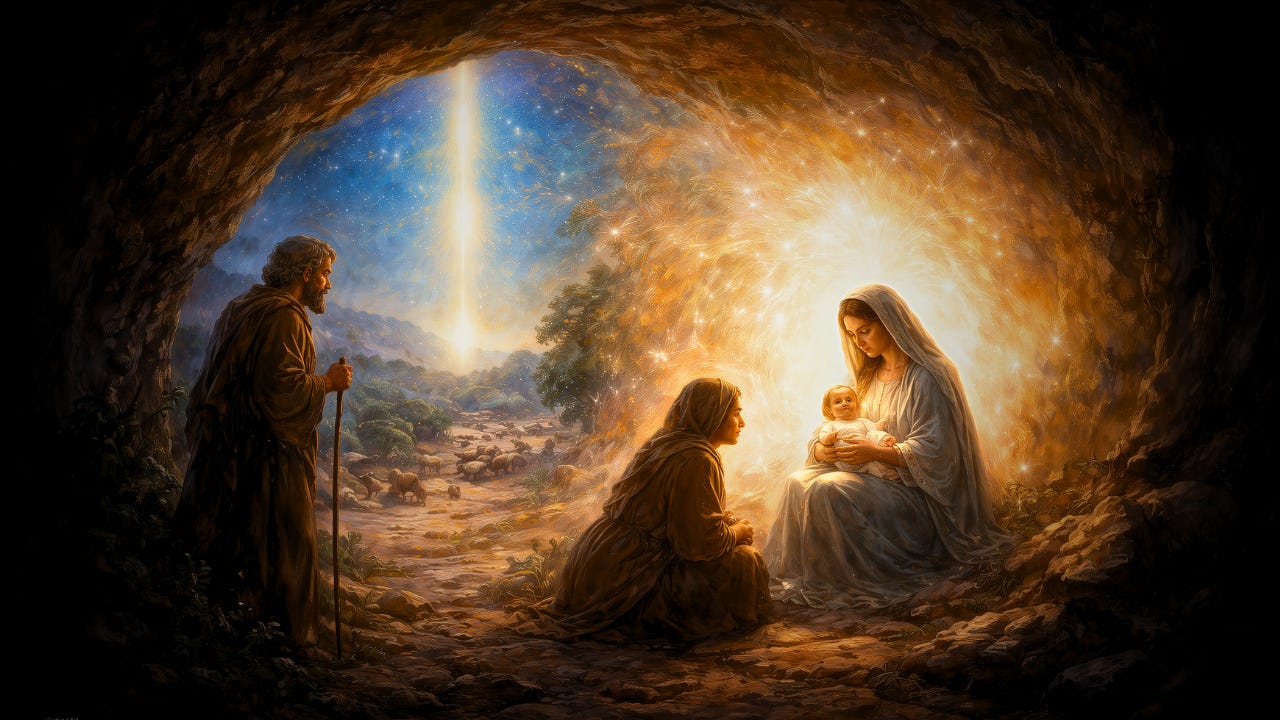
Like Rachel, Mary goes into labor while they are on the road. In a panic, Joseph finds a cave, a place where he can take her, where she will be safe, and then rushes back out to find help.
This depiction of Joseph shows him as older and wiser. That is not so much for Joseph’s benefit as it was the need of the patriarchal society around them to insist on Mary’s perpetual virginity, a flawed doctrine that this story returns to again and again. But in the midst of its retelling and its colonizing propaganda, there is a moment that shines through, because the power of the incarnation, of the Gospel itself, cannot be contained even in the cages that are built for it by Empire.
Walking and Not Walking
Joseph narrates his run from the cave, and there he says something profound: “I was walking and was not walking.” This is the nature of the way and what we are constantly seeking to do in our own lives.
When we are walking and not walking, we have become one with the flow of the path. We are one with the action, united and indistinguishable from it. It has become embodied within us. This is what we mean when we use phrases like “living God” or “living Christ”: that these ideas, these facets of our belief, are so well rooted within us that they become our lived reality through which we act in the world.
When Joseph walks without walking, he is entering a state of mindfulness where his mind, heart, and spirit are united in the actions of his body. The intent is clear and focused. He has to go and find help for Mary. He has to find the resources he can to support the fragile life of the child about to be born. Everything is clear and united.
As we learn to walk the path, we cultivate this mindfulness within us, so that our actions flow from us rather than having to be instructed or told to happen. An easy way to understand this is to think about how, in a comedy or sitcom, when someone is acting and told to just stand there, they start obsessing. What are my hands doing? What are my legs doing? Are my hands in my pocket? What is my posture? What am I doing?
They are overthinking an action that they do regularly throughout their daily life. If they would just stand like they would stand, then it would be easy. In other words, stand without standing.
When we first learn any art or practice, our mind runs through the instructions over and over again. We check ourselves to make sure that we are doing it right, and that is part of the learning process. The moment we realize we have actually learned it is when we do not have to think about the instructions. We execute them. We do not have to think about what the next step is, we just go there.
That is a level of mastery and self mastery to which we can all aspire. When walking the four paths, especially here in the Via Positiva, we learn to just walk, walk it, one and the same, without having to remind ourselves to stop and look for awe, wonder, and delight. And when we are in that pure moment of walking without walking, the world can open up to us.
When the World Stills
As Joseph walks without walking, the whole world stills, not just his mind. He looks up into the heavens and sees the pillar of the sky. Like the Shekinah of old that guided the people through the desert as a pillar of smoke by day and a pillar of fire by night, he sees it there still in the sky, bridging heaven and earth.
The birds are still in the sky, neither flying nor falling. The animals are frozen in mid action. People who are standing up are in mid stand, and those who are sitting down are still sitting. The river itself does not move.
This is the moment of pure mindfulness where the apocalypse happens. Revelation comes to us in these still, small moments where the world drops away, all of our cares and concerns fall by the wayside, and we are purely there in the moment, able to see the wonder and experience the awe ever present around us.
The cosmos is not doing anything. And neither, honestly, is Joseph. He is present in a way that reveals the cosmic wonder and spectacle happening around him at that moment in time.
Mutual Care Enters the Vision
To Joseph, the entire world is frozen, congealed in this moment of spectacle, awe, and wonder. But he sees Salome coming towards him. She speaks to him, and he responds and tells her of his great need.
His eye is drawn to her because she is there to give the care that they need in the moment. The moment itself opened up and his eyes were clear to see not only the spectacle around him, but the mutual care embedded in the community as Salome approached and offered to be of aid.
Joseph learns in this moment what Jesus would teach one day, that we should be anxious for nothing. For God takes care of the birds and clothes the plants with such radiant splendor. How much more will God take care of us?
This is not waiting for a handout from the universe. Joseph is actively engaged in going to seek help, and God, who exists as an intermediary between the two in the presence and mindfulness between these two people, connects them so that he finds the need that he has answered in Salome.
We do not wait for God like a divine vending machine, but instead actively participate within that presence so that presence may call to us what we need. It is through action, prayer, pure mindfulness, and intention that we are able to live in this mutual care.
Nothing had to change in Joseph when he saw Salome approach, or when he heard her voice. She was the answer to the prayer of his heart, someone to help him usher a new child into the world.
The Cloud of Unknowing
Joseph invited Salome into the great walk without walking that he was doing, and as they returned to the cave, her eyes are opened. But unlike Joseph, who saw the splendor, the Shekinah, the glory of God in the sky, she sees the great cloud of unknowing in the cave.
She cannot see Mary or the midwife. She cannot see what is happening there, only the great unknowing. We like to forget these days that unknowing is a revelation in and of itself. It reminds us to let go of our preconceptions.
In the story, Joseph tells Salome that the Savior is being born. He announces the gospel to her and she, though intrigued and welcomed into the mystery, cannot fully understand what was said to her. She sits with the mystery as it is, mystery.
This is not a failure on her part, nor is it a flaw in her character. She has not forgotten to do some spiritual or mystical practice that would have opened her eyes. At first, we always perceive the mystery, the great cloud of unknowing that reminds us of all that we have to unlearn to get back to that beginner’s mind where we can see clearly, where all of our preconceptions are washed away and we can see the world as it really and truly is.
To see that original blessing and original grace that was always there, but clouded either by life experiences, stories we have been told, or dogmas that have been placed upon us to hide it from our view, takes mindfulness to even perceive the cloud of unknowing and to receive the revelation that it has to offer us.
The Light That Reveals Form
Once Salome sits with the vision of the cloud for some time, it breaks open into bright and dazzling light that fills the entire cave. The cloud did not change. The light is as blinding as the cloud was, but now she can see the radiance within it.
Salome has moved deeper in her mindfulness in the moment and is no longer just stuck in the awe of the cloud, but is now getting to glimpse the full wonder and glory that she could not perceive before.
This light is common in most mystical traditions. It has many names, but the one that we use is the Taboric Light, because it is the same light that shone atop Mount Tabor at Jesus’ transfiguration. This light is the radiance of the One Life, the living God shining between and betwixt all of the people and things and from the place itself.
This light is HaMakom, the place where God is. This is also the light in which Jacob wrestled the angel. It is the light that opened up and revealed so many things to Daniel, Isaiah, and Ezekiel. It is the light that resonates with the song of the angels: Holy, holy, holy. The earth is filled with Your glory.
Then the light dims and Salome beholds the mother with the Christ child at her breast. Again, nothing has changed. The Madonna and Child, the brilliant light, the mysterious cloud of unknowing, these are all three ways of seeing and beholding the same mystery.
The light does not recede, but reveals form. The cloud is not gone. The mystery remains. Through this great apocalyptic vision, Salome has seen the mystery, the presence of God, and the mother and child, all one and the same.
That is how the apocalypse works. We behold the mystery. It opens to wonder and reveals presence. That is the cycle of apocalypse.
The Via Positiva and the Unveiling of Wonder
This is the power of the positive way, the Via Positiva. We walk this path any time we encounter awe, wonder, or delight. When we greet these with hospitality in our hearts and mindfulness, and allow them to open and unfold, they go through these same three stages.
They open us to mystery. They reveal unseen glory. And then they show us that mysterious presence that has always been there without our notice.
We can do this today. You can do this right now.
What is your favorite fruit? An orange, apple, mango? Sit with that fruit for a minute. Really look at it. If it has to be peeled, as you peel it, smell the fragrance that arises from it. Ponder all of the things that went into making that pleasant aroma and that delightful sight.
Enter into its mystery. Where it came from, the ground that nurtured it, the air that gave it rain, and the hands that picked it, and all those involved in bringing it there before you. Sit mindfully with all the many things that it took, from the fiery heat of the Sun to the coolness of night, to the rain, to the soil, to all of the things that live in the soil to bring the nutrients to the roots of the tree, to carry it up so that the tree could flower, and the insects that it took to pollinate the flower, and all the care and time that it took for the fruit to grow, ripen, and mature, and all the hands that it passed through just to get to you.
Do you not feel a certain sense of wonder in that miraculous journey? More often than not, the difference between the miraculous and the mundane is the way we receive the event.
Go through this process again when you taste it. How it makes you feel, the things that it is bringing to your life, both emotionally and physically. You are eating sunshine and rain and life that has been forged, going all the way back to the very first fires that flared forth at the moments of creation.
That is just one way to enter this wonder, to experience this awe, and to have a moment of apocalypse.
In all of the others, the process is the same. You open with awe and enter the mystery, and you sit with the mystery until it opens you in wonder, and then through that wonder, experience the presence of what is truly there.
This is the power of the Via Positiva, the great positive way that grants us this apocalyptic way to unveil the glory of the world.