


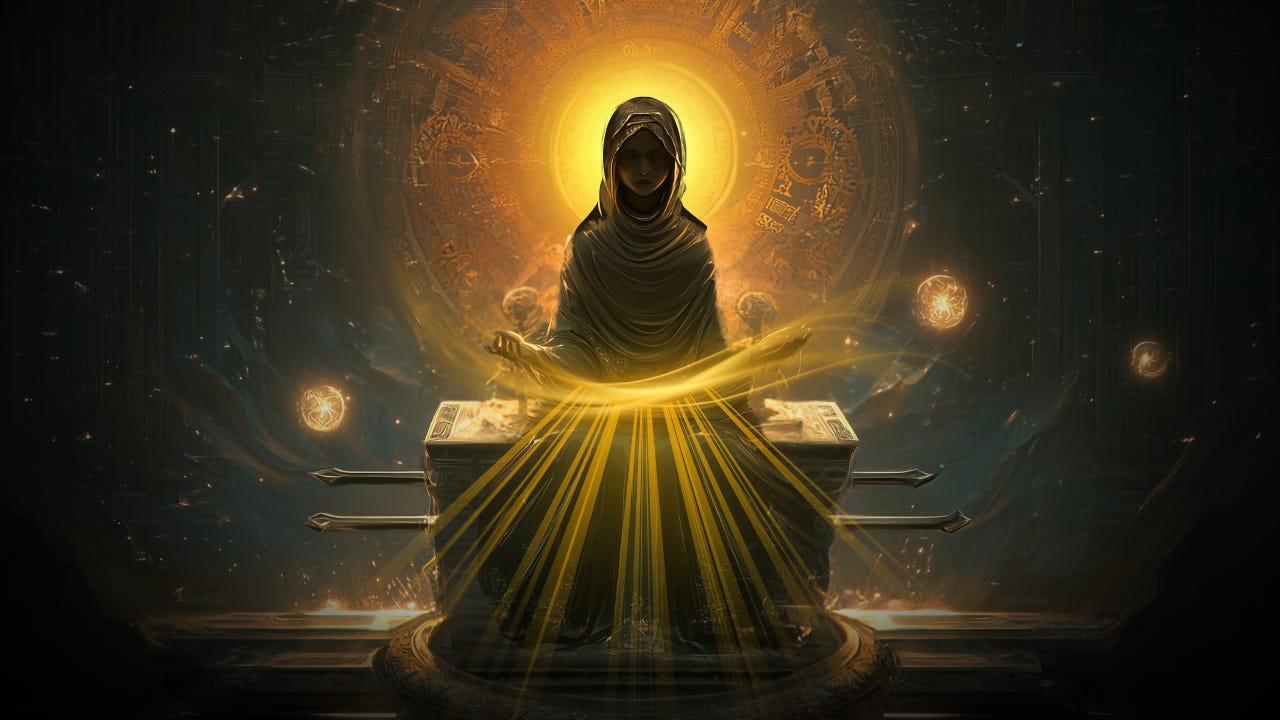
Entering the Dark Womb of Advent
It is impossible to enter the mysteries of Advent without thinking about Mary, the Mother of Jesus, The Mother of God. Many these days spend their time and effort seeking out the historical Jesus and Mary, and while that is helpful to the faith, in these devotional times, I am more focused on the relationships we have developed over the centuries with the Cosmic Mary we meet in story, statue and song.
Personally, I credit our Blessed Mother with my life, and I’ve had a deep devotion to her for most of it. That devotion only deepened when I started practicing Creation Spirituality decades ago.
Mary is the Mother of the unseen Light and the unheard Word. She is far more than a figurine in the Nativity scene. She is the first sanctuary of the Incarnate Word, and the model for Living God.
I am not talking about a living god that exists somewhere in the cosmos, but the process of Living God in her mold. We are each the mother and child of God and through living in awe, openness, creativity, justice, and celebration, we live love, compassion, return and reparation into the world.
Mary models and teaches us how to live God in every moment of life through her participation in all the major events in the life of Jesus, and through The wisdom we glean from the relational apparitions that have come to us over time.
Mary the Immaculate Conception: Icon of Original Blessing
In 1858, Our Lady appeared to St Bernadette Soubirous in France. At the culmination of those apparitions, Our Lady said something that many theologians have yet to grapple with. When Bernadette asked Our Lady what her name was, she said, “I am the Immaculate Conception.” She didn’t say I’m the product of or the result of, the fruit of the Immaculate Conception. She said, I am the Immaculate Conception.
While the church gave its approval for the devotion to the visions in 1862, it has yet to grapple with the enormity of the revelation received there.
In the traditional framework of Catholic theology, Mary is born of the Immaculate Conception, which means that she, alone amongst people, was born free from original sin. This was necessary to find a way to explain why Jesus himself was not born with original sin. Personally, I think it would have been better to have taken that issue and re-evaluated the new and novel doctrine prescribed by Augustine (around the 4th and early 5th century AD) and those who came after him, but the church decided to run with it because it allows them to have that power.
The words Our Lady gave St. Bernadette at Lourdes challenge the very notion of original sin. If Mary is the Immaculate Conception, she is the very embodiment of the original blessing in which we are all born. As the Immaculate Conception, Mary is the original grace, the original wisdom, the original mind, and the original blessing through which God created the universe. In her, we find our matrix of discipleship. In her, we find the womb that will help Christ to be born within us and to help us live our Christhood in the world.
In many traditional prayers, Mary is referred to as the Ark of the Covenant and the Treasurer of the Divine Grace. St. Louis de Montfort said that Mary is the one through whom all grace enters the world, that she stands at the gate of the divine treasury and dispenses grace through her loving mother’s heart to all the people in the world. To me, that sounds like Mary as Original Grace.
The doctrine of original sin is foreign to the scriptures and unknown in the early church. It arose in the late fourth century and ended up taking over the church as a means of control. After all, if a person is born in sin, then they require an outside intervention to free them from sin, or they will be forever separated from God. If the wild, prophetic movement of the early church was going to be brought into the control of the empire, then it had to be placed on a leash. Original sin provided the rubric for them to do that.
If Mary was not born as a product of an Immaculate Conception and is in fact the Immaculate Conception, then she is a force in this universe as strong as any others, able to awaken us to the power of the divine flowing in every moment. She was a witness to all of the most important parts of the Christ story. She was there through everything from the Annunciation to His birth, through to His crucifixion, resurrection, and ascension into heaven. She was there when the Holy Spirit descended on Pentecost. She was our stand-in. She is the one who represents us in all of these stories. The one born in original blessing, the one connected to original grace, and the one who participates in all the divine mysteries.
Mary becomes not just the mother of God, the mother of Christ, and the mother of Jesus, but the mother of the Church, the mother of the faithful, and the mother of all living. Our Lady is the Immaculate Conception, the Divine Mercy, the Original Grace, Original Blessing, Original Mind, and Original Wisdom. She is the one who not only stood for us in the original stories but the one in whom we are formed into the image of the cosmic Christ who lives, who sustains, and maintains the universe, and who holds the cosmos together. She is the eternal reminder that God enters the world through blessing, not through fear.
Mary as the Black Madonna
Starting in the twelfth century, many icons and statues of Mary were made from dark wood or painted with dark skin inspired by the passage in the Song of Songs, “I am black, and I am beautiful” (Song of Songs 1:5). The woman speaking in the passage was identified as Mary talking to God. These were not the first Black Madonnas made, but it is at this time that pilgrimages to them and devotion to them begins in earnest.
“I am black, and I am beautiful” means that the sacred is often found where society fails to see beauty, and that darkness itself can be a site of divine presence, dignity, and desire. When it was written it referred to someone who didn’t have the fair skin of someone who didn’t have to work out in the sun, connecting this woman with people who had to work to live, or the poor.
In the centuries since it was written, the phrase has been connected to the Shekhinah, or presence of God, and the Blessed Mother Mary.
Mary has taken on the qualities of the Shekhinah. She is the sheltering presence who guides her children, shares the wisdom of God, and who shines with the glory of God. She is often called the bride of the Holy Spirit which carries many images of the Sabbath Princess/Bride.
Over time, Mary accrued the mysteries of earth, grief, and resilience. She is Queen of all hearts, Our Lady of Sorrows, Our Lady of good counsel. She is the sacred night in which the Light is conceived. Her darkness is not the absence of light, but the secret place where the presence, the fertile ground in which the Word roots itself. She welcomes the wounded, the weary, the exiled; she knows the underside of empire and refuses to bow to it.
Mary is the Mother of Mercy, whose gaze refuses to shame. She is Mamma Schiavona, the Madonna di Montevergine, who embraces the queer community and all those we seek refuge in her fierce protection.
Her mercy is not softness. It is the fierce compassion that bends the world back toward healing. There are stories about her striking down slavers hunting down escaped enslaved people and setting them free. Her compassion is a consuming fire that burns away what stalks to harm her children.
In her mercy, we rediscover that the Holy sees us whole even when we feel broken. In her loving arms, we discover who we were always meant to become.
Mother of Divine Grace
When we see Mary in a Nativity scene or think about her struggling under empire to get to Bethlehem to give birth to the Divine Child, we must remember that she is not journeying just to give birth to Jesus, but to give birth to us. She is the mother of Grace and all who live and breathe.
She is the fountain of grace, not as a dispenser but as a living window into how Grace works. She is the first to proclaim the Gospel while she was still pregnant with the Christ Child:
Luke 1:46-55
46. Mary said, “My soul magnifies the Lord.
47. My spirit has rejoiced in God my Savior,
48. for he has looked at the humble state of his servant. For behold, from now on, all generations will call me blessed.
49. For he who is mighty has done great things for me. Holy is his name.
50. His mercy is for generations of generations on those who fear him.
51. He has shown strength with his arm. He has scattered the proud in the imagination of their hearts.
52. He has put down princes from their thrones. And has exalted the lowly.
53. He has filled the hungry with good things. He has sent the rich away empty.
54. He has given help to Israel, his servant, that he might remember mercy,
55. As he spoke to our fathers, to Abraham and his offspring forever.”
The Gospel of Creation sings with grace. The Holy One moves with mercy toward all who live in awe. Pride unravels in that light. Thrones lose their grip. Those who have been pushed to the margins are lifted by the work of the community. The hungry find their tables filled with abundance. The ones who hoard find their hands empty, invited to begin again. This is the good news. The world is turning toward justice, and we are welcomed into that turning, welcomed into a life shaped by awe, compassion, and the fierce renewal that flows through all creation. We are not perfect in the work of the Gospel, but it is our calling to perfect that work so that everyone is taken care of and healed.
Grace is the flow of God’s life through all things. Our Lady is the beating heart pumping that grace into the whole cosmos. She is our model. She is the one who said, “Yes!” Yes to giving birth to the Divine Child in the world, the One who bears the Holy Name of God which is being itself.
We embrace grace when we live in the strength to say yes to becoming that font of grace into the world. Mary reveals that grace is woven into our bones, and is the truest nature of our being and doing.
Like us, Mary is created by God and mother of our Creator. We are called to do the same. The seed of the tree of life is planted in every heart as we are all born in the Image of God, existing and capable of doing. It is up to each and every one of us to nourish and water that seed so it might grow.
Mary is the bearer of the One who bore her. She is the model for us and how we should live our lives. This mutual indwelling shows us the pattern of reality itself: God desires relationship, cooperation, incarnation. God lives in the moments of action and hope. This is how we live God into the world.
This requires us to change the way we conceive of the world. Mary’s motherhood is not hierarchical; it is participatory. She participates in the life of the community and bares God into the world. She shows what it looks like for a human life to be in full reciprocity with the Divine.
Mirror of Justice: Reflecting the True Order of Love
The order of love (ordo amoris) taught by Mary and Christ rejects the ladder of love taught by Plato, where we have love for those closest to us and that love fades the farther out others are from us. As taught by Augustine and St Thomas Aquinas this is that we love equally everyone who is our neighbor, and everyone is our neighbor, so we love everyone equally. This is the heart of Mary and Jesus’ teachings.
Mary is the Mirror of Justice. She shows us the love that does not differentiate between ourselves and others. That compassion is the root of justice. Not retributive justice, but right-relationship justice. Living in this compassion, we do not show favoritism, hoard wealth, or allow others to suffer. In her life, the world sees how God orders the cosmos: through humility, consent, solidarity. In her presence, empire trembles because she reveals a world grounded in love rather than domination, which is why empire always seeks to co-opt her message and that of her son.
Seat of Wisdom
Mary is the seat of Wisdom. When we sit on her lap as her loving children, we have access to her deep wisdom. Too many sit on her knee and try to overshadow her so they can pretend they are important, wise, and powerful.
In accepting her quiet wisdom, and pondering everything in our hearts as she does, we access the insight available to us in every moment. She becomes the throne where infinite Wisdom meets finite flesh, the place of contemplation where we enter into the great cloud of unknowing to become wiser.
Mary invites us to become places where Wisdom rests, where compassion and clarity take shape in our lives. We are called to bear the Divine into the world, just as she was.
Ark of the Covenant
Mary is the Ark of the Covenant, bearing within her the law that is written on our hearts and the rod that blooms.
The law is simple:
Matthew 22:37-40
37. Jesus said to him, “‘You shall love the Lord your God with all your heart, with all your soul, and with all your mind.’
38. This is the first and great commandment.
39. A second likewise is this, ‘You shall love your neighbor as yourself.’
40. The whole law and the prophets depend on these two commandments.”
God is a verb, so to love God is to act in awe, openness, creativity, justice, and celebration. When we recognize that everyone is our neighbor, and love them in the same way, we fulfill the whole of the law.
The rod that bloomed is the staff of Aaron, the sign of our priesthood that blossoms as a shoot of the tree of life when we water it with our actions that keep the laws of love and liberation.
Mary is the gate to the portable sanctuary of God’s promise:
that the Sacred dwells within us, not beyond us. She reminds us that the world is sacred as is our work in it. Through her, we learn to carry holiness in our bodies, our choices, our relationships.
Let the Black Madonna Conceive the Word in Us
This is the call. Like the angel who called Mary to bear the Holy One, Mary now calls us to become:
Bearers of mercy, living compassion into the world.
Vessels of grace, tapping the Original Grace of the cosmos and offering it to everyone we meet.
Reflections of justice, bring equity and right relationship to everything we do.
Seats of wisdom, offering what we have learned to help others live better than we have.
Living arks of divine presence, where God lives through our actions, words, and choices.
The Black Madonna guides us through the dark womb into the birth of the Light. She teaches us to trust the depth, to trust the slow forming, to trust the grace already at work in us.
Through living as she lives, we open the paths of grace, blessing, and wisdom, to those who need them, and especially to ourselves. We become the light that shines into the world and scares away the darkness that cannot overcome it. We preserve the world and restore what we can for the world to come.