


The Child Who Calls to Us
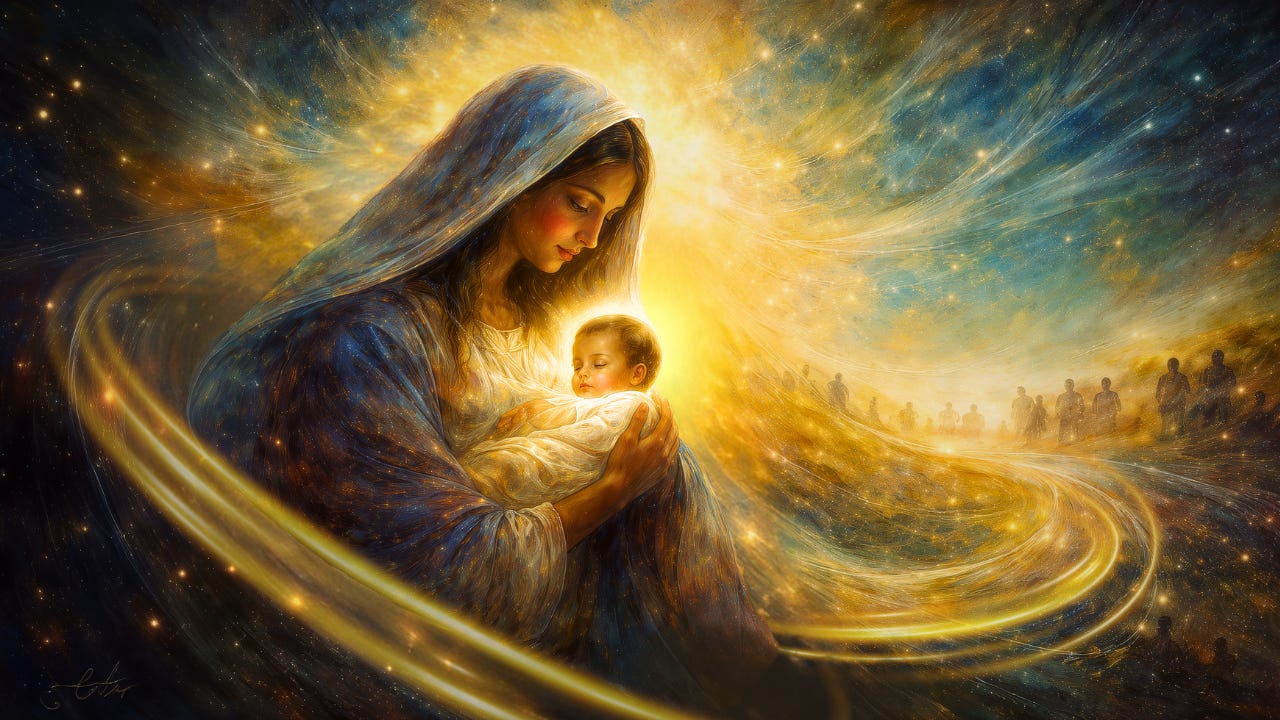
When we think about the Christ child, a myriad of images might dance through our minds. The sweet baby in his mother’s arms, a divine child surrounded in a halo of light. A smiling child. A crying child. A child in fear and confusion as his family runs to seek refuge in Egypt.
None of these is the right image, and none of them is the wrong one.
We will gravitate to the image that speaks to us most in the moment. When I say that the Christ child is the child of healing, the first image that comes to your mind probably tells you more about what needs healing in your life right now than anything else.
It could be a traditional image that you grew up with, a Christ child that has been interpreted in your own ethnicity, or a child who tries to reconstruct life in first-century Palestine. Whatever image comes to mind, our goal is to seek revelation from it and to understand why that is the one that is calling to us in this moment.
For example, I’ve been thinking a lot lately about my devotion to the Infant of Prague. And so that image of the Christ child, crowned and holding the orb of the Earth, while bestowing blessings upon its inhabitants, is quite clear in my mind right now.
Sitting With the Image
Whatever image arises, sit with it. Look for your connections to it. Does it remind you of an experience from your past or something that you have seen lately?
This is how revelation happens. It is in understanding the relationship between the images that we cherish and hold dear and the world around us. Without that relationship, the image itself is meaningless.
As we sit with this image, we are connecting both to it and to the ground of our being. We are learning to be, to live God, to live Christ. We are learning that intimate relationship where everything is interconnected and all things derive their meaning from those connections.
The Interruption of Isolation
Now ask yourself, what would it feel like to hold that child? Are you allowed to hold him? What would it mean for you to hold the Christ child in your arms right now where you are?
If something arises within you and tells you that you either could not, cannot, or do not deserve to hold that child, that you are not worthy to even be in the presence of that child, interrogate that.
The thought might not be that clear. It might just be a fear or worry, a freezing in place that prevents you from moving forward. It often manifests as a coldness in the body, a chill, a static freeze that holds us in place.
That interruption in the flow is what isolation feels like.
Isolation is the misconception that we are somehow separated from the whole. We find excuses. This is to magnify it and give it strength, even though none of us is ever truly alone. Each and every person is a vibrant ecosystem, living and breathing together.
But isolation speaks up and says, “Oh, but that’s not what I mean. There are no other people around me.” Then go somewhere where there are people. Isolation speaks up again and says, “Oh, but I don’t have any connection with those people.” So I still feel alone even in the crowd.
Maybe we don’t feel alone, but we feel ostracized, pushed out to the outskirts, and not welcome or invited in. That sense of isolation breeds loneliness within us.
I could tell you that no one is ever alone, that we are all interconnected in God and that there are a myriad of spirits around us at all times. But that is empty comfort when we feel alone and isolated.
The kind of isolation that is so prevalent these days is born from us putting walls up to protect ourselves and others doing the same, so that no one is letting anyone else in. That lack of trust is the root of most loneliness and isolation today.
Turning Inward Without Blame
When we encounter this sense of loneliness or isolation, it’s easy to externalize it and blame other people for it. I’m not saying that society cannot be cruel and isolating, that people cannot be standoffish. There is an element of that in the feelings that we have.
The problem is we do not have control over the feelings and actions of others. We cannot make others change. Change comes from within.
What we have to do is examine within ourselves what qualities are there that are keeping us separated. It may be a trauma from our past that needs to be healed, or a fear of what would happen if we were our true selves around others. The causes of this internal isolation are too numerous to list.
Since we cannot control others, but only affect ourselves and our immediate surroundings, we need to find what we can in ourselves to change, to transform. Not to conform to the world or the expectations that are put upon us, but those flaws in our thinking that cause us to believe that we are unworthy of relationships or that we do not deserve to be happy.
The better we become at eradicating words like “deserve” and “worth” from our minds, our vocabularies, and our ways of thinking and being; the more readily we will be able to connect to others.
Trust is born within. We must first learn to trust ourselves and then expand that circle of trust as we learn to negotiate relationships with the world that are healing and nurturing.
God as Child, God as Verb
In the Creation Spirituality tradition, we not only believe but practice this idea that God is as much our child as our parent, our loving mother and father. This is the heart of mutual indwelling.
In order to trust that image, we have to test it. What would it mean for us to hold the Christ as our child or to be held as his?
To this, we apply effort. We try it out. That seed of faith is born in us, but it will either fall on dry soil or it will find a place to root. It’s through effort and trying it out that we can start to learn.
In the midst of that effort, we bring our mindfulness to it, noticing what changes and what doesn’t change, what needs to be changed, and what needs to stay the same. We concentrate this experience down to its most vital essence.
That concentration is the core of that energy that we have expended through effort and our mindfulness pushing forward. In the end, we achieve wisdom.
That wisdom might be that the effort we put into the thing we had faith in didn’t work. And so we gather again, find a new thing, and we plant that seed of faith, apply that effort, mindfulness, and concentration, and gain more wisdom. Because knowing what doesn’t work helps to narrow down and focus us on what will.
Carrying the Child Into the World
When we imagine ourselves holding the Christ child, we ask ourselves what would that mean in our lives. Not just in a visualization. What would that mean in real care and concern for the world and those around us?
How would that change how we react in our lives?
As we start trying those things, and we see which ones work for us and which ones don’t, carrying the Christ child becomes lighter, more real. We open ourselves up to a new vulnerability to that experience so that we can welcome it in.
Life flows through those vulnerable moments. Trust teaches us who we can be vulnerable around and when the right time for that vulnerability is.
Compassion, Mindfulness, Justice
As we break free from this sense of loneliness and isolation, compassion is born in us. Compassion is this fellow feeling that we have for others who walk the way.
It is not pity. It is not concern. It is a knowing that we share this life in common, and so what happens to others happens to us. We can see this most readily in our trusted relationships.
Compassion softens our hearts, and we see its lack more acutely in more places in our lives.
Mindfulness, which is one of the engines of this change, this transformation, opens our eyes so that we are clear in the present moment, not relying on memories of the past or prognostications about the future. We are here in the present moment, in the eternal now, living.
From mindfulness and compassion, justice-making arises naturally. Our sense of right and wrong has become relational, and injustice is anything that interrupts that flow of relationship and does harm.
Now we have opened up to the world, and we see our interconnection with it, and how all things depend on each other and arise together.
The Ripples of God-ing
In holding this precious child of light, we learn that life is as much a product of what we do as we are a product of it. Through the process of living and being, we live God and live Christ into the world.
God is a verb that mutually interacts, where both sides are the subject and object of each other.
As we set this image down to walk into our ordinary lives, we realize how everything arises through dependent origination, that through this endless chain of cause and effect, the whole cosmos is made.
Every cause, every action that we take with deliberate intentional care, filled with compassion, mindfulness, and justice, changes the course of everything as those little ripples spread out and cause greater change.
Everything is interconnected. None of us is above another. Even those who seek to isolate themselves from the world are still dependent upon it and enmeshed in the great chain of being, where each and every one of us lives in this web of interactions.
This transformation focuses our attention so that we’re looking for those ripples, where we can cause them and where they’re affecting us. We feel it in our bodies, and we work it out through our hands, our words, our actions.
Once we are healed by the Child of Light, then we see that we are a part of this great seamless whole.
What then can we do but care for one another?