


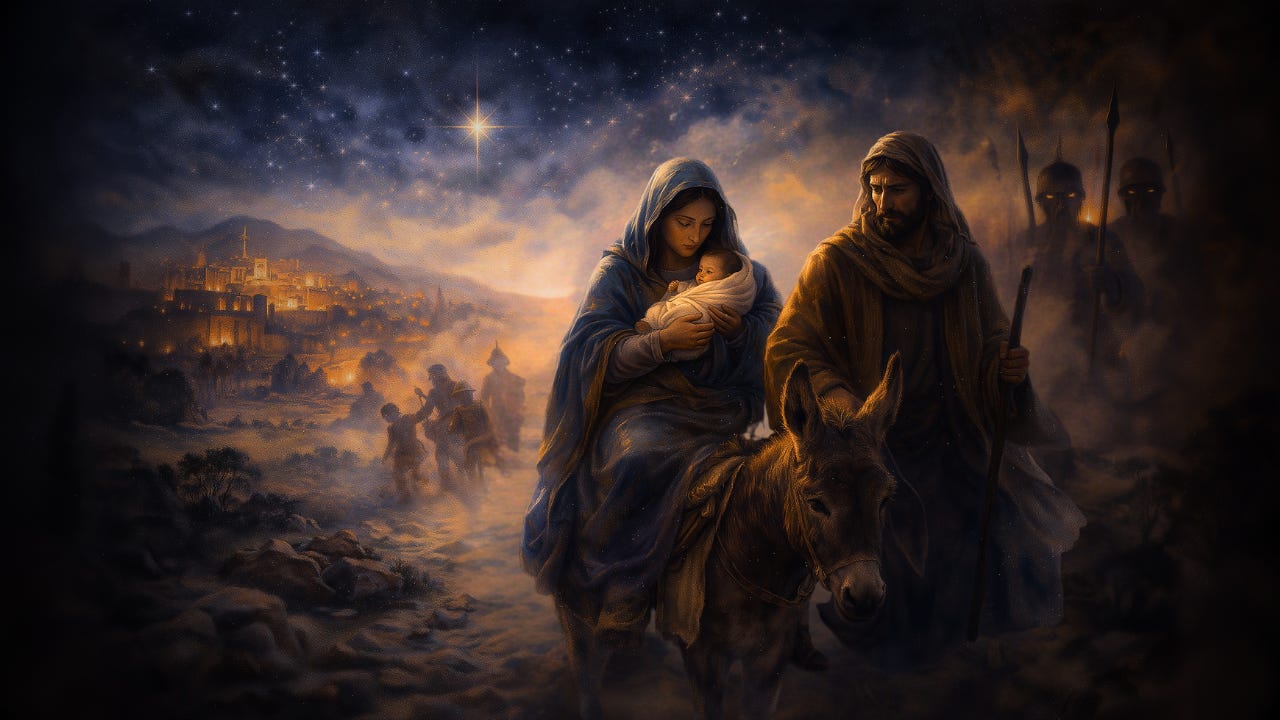
It’s a familiar image. A frightened young girl riding a donkey while her husband leads them on. The Empire has forced them from their homes, and even though she is soon to give birth to their child, they have to travel. They have to move. They are refugees in their own homeland.
The couple is forced to pick up everything that they have and move to a place far away because a faceless empire demands it. Not long after they arrive, she goes into labor. Her husband flees out into the city in hopes of finding a midwife. This is their first child. Separated from their family. Finally, the young girl gives birth, and they name the child Jesus.
Not long after the child is born, they are forced to flee again from another imperial tyrant threatening to murder their child.
Many place the story in the city of Bethlehem. From this insignificant city, crushed under the boots of empire, something holy happened. God takes on human flesh. That terrified couple becomes the parents of the creator who made them.
Before anyone wrote songs about this city or the silent night in which the child was born. Before the child was seen as holy and his mother as blessed, this place, these people, were already holy. Their holiness did not extend from what they had done or because of the special circumstances of their life, but because they were already held in the One Life flowing through all things, recognizing all as holy.
To this day, this scene plays out somewhere in the world: a frightened mother giving birth to a child under an oppressive regime. Soon they too will have to flee for their lives. Yet life goes on, and the holy is there among them.
# God chooses dependence
The real power in this story that we tell every year is not that God chose to arrive in glory. Jesus wasn’t born as a king, and even the magi who came to worship him and proclaim him a king had to seek to find him because he wasn’t born in a palace. They understood the risk to seek him out. The risk that they were putting on their own life and on the life of the child, which is why they had to flee themselves to escape the wrath of Herod.
The incarnation of Christ is not a story about glory. It is a story of risk. God enters the life of humanity not in power on a throne, but in the most fragile, vulnerable position that He could. He chose to depend on a young girl and an untested father. The threat of Herod’s wrath loomed over them, and the terror that could rain down any second from the Roman Empire filled every moment of their lives.
The incarnation of God depended on so many things. The health and well-being of a young woman’s body to carry the child to term. The mercy and compassion of her betrothed not to cast her out and have her stoned for carrying the child that was not his. It relied on the help of strangers and the wisdom of the Magi not to turn them in. The warmth of the animals kept them cozy at night. If the Empire noticed and cared, it could have snuffed out their lives before we ever heard of them.
It makes you wonder how many times this played out before but did not end with a live child in the end, that did not end with the Holy Family safe and living. They were able to find the hospitality and the compassion to survive in these harsh times. The compassion of their community and strangers gave them hope. They weren’t empowered by hierarchy, but by the communion of all those who supported them through these days.
That’s the power of this story. The indwelling communion of God and Christ keeps them alive through people living God through compassion and hospitality. God did not lower Himself to save us. God entered the same fragile web of community and connection that we already live in. If that web had broken, we would never know the names of Mary, Joseph, or Jesus.
The incarnation is not God arriving in control. This is a God who entrusts themself to the world.
This is how the story is remembered. But even if Jesus were born and lived his entire natural life in Nazareth before starting his public ministry, everything I said is still true. The empire of Rome controlled and brutalized Judea and the Galilee. Mary’s own family were refugees from Sepphoris.
Every child requires this web of compassion to come into the world. For God to trust humanity so much that He would enter into this web with us is a marvelous and mysterious thing.
# Moments of Revelation
Since story is how we engage with the world, let’s continue digging into the story that the tradition has held so close to its heart for all these millennia.
## A Revelation of Wonder
Every newborn commands attention without explanation. When we look into that fresh face, we feel this awe wash over us. New life has come into the world. In that moment, we understand deep down in our bones that life is sacred. And when we see such a small thing breathing, it brings wonder into our lives.
The stories tell us that when Jesus was born, angels appeared in the heavens to shepherds who were watching their flocks, and they called them and told them where the child was so that they could go and behold this wonder. They sang a blessing over the earth, that there would be peace amongst those of goodwill. These are the ones who strengthen the web and nurture life, especially the fragility of newborn life.
We awaken to this awe in the face of every newborn child, and every morning as the sun breaks over the horizon at the dawn and as it sets into that beautiful twilight before night. As the stars fill the heavens, the awe awakens us to all the glories of life.
## A Revelation of the Indwelling God
The One Life flows through all things, from the straw in the manger that insulated the baby to the breath that warmed him. The animals heated the air. Creation did not step back from incarnation. It made room for it.
The cosmos itself bowed in as life incarnated into this sweet child. The one light in the heavens guided the Magi through a star. It told them that a king had been born, and they went and sought him, seeking that light within them. The shepherds felt the light erupt around them as a grand aurora in the sky of angels proclaiming the glory of God and peace on Earth to people of goodwill. In the Proto-Evangelion of James, it says that time itself stopped at the moment that Christ was born.
The life that is in all things took a drop out of the ocean and filled the sweet child with it.
## A Revelation of Emptying
As the one life poured itself into all those there and present, so much more was poured out into the cosmos. Mary poured her soul out to the limit to give birth to the child. Ask any woman who has given birth how much strain and intensity flows through them as the child is born.
The Magi gave precious gifts. The shepherds risked their flock to go and see what the heavens had proclaimed to them. Mary and Joseph gave up everything to make the arduous journey to keep the child safe.
Emptying is not the negation of the self. It is the giving of the self into relationship. The relationship between Joseph and Mary, between them and the child, between the three of them and the divine, and between all the people that would come into their lives and themselves. God does not pour out power, but presence.
## A Revelation of Original Blessing
No one in this story required purification. Mary was found by the angel to be full of grace when he announced the child and asked if she would bear him. While Joseph required some gentle guidance, even his heart was found pure in that he wanted no harm to come to Mary, even though he could not understand what was happening to her.
We don’t have to be made worthy before God arrives. God arrives in each and every moment without prompting. God is already within everything and everyone and calls it good.
The story doesn’t tell us about the faith or the morals of the shepherds or the magi. They did not have to be worthy to come. They were called, and they came. The cosmos called out to them, and they heard. Moreover, they listened and lived God by acting on what they heard.
All of these people lived in original blessing and original grace. And God incarnated to indwell among them.
# Indwelling Communion
This is the indwelling communion of Christ. Christ was with them and within them, around them, and through them. He is revealed through their actions, which are the sign of their faith. After all, faith is just the courage to act out of that great sense of awe and wonder, openness and silence, the willingness to let go and let be, to be creative, to make justice, and to celebrate with joy.
Christ is not here while we’re over there. God did not visit us from outside. Through shared life, shared vulnerability, shared breath. We live the One Life, and the Incarnation is always present with us.
God is within us, and we are within God. Christ is within us and we are within Christ. In this mutual indwelling, we share a communion at the deepest level.
# Christ in us, the Hope of Glory
Not just now in this season, but especially now. We find ourselves asking, where is life being entrusted to our care? Right now, in this moment, in this breath. Where is life calling to be born? Where am I called to go? What am I called to do?
That is the light shining on the path before us, and the wisdom and word resonating deep inside, guiding us to live God continually and without end, living our lives as prayers without ceasing. In living with wisdom, compassion, justice, and equity, we are forging a brand new and beautiful world.
Who is being asked to make room? The world did not have to break for God to enter. The only thing that was required was a yes. A series of yeses, one after another after another, until the child was born.
Look, where are we being called to now? Where is your attention going? This is a shift within us and our attention is being called somewhere. This is not a God asking to be worshipped but a God asking to be held. In our deep and fragile human vulnerability, in a world threatened by the same forces it was back then, we with open eyes look out to see where Christ must be born.
While we celebrate Christmas once a year, Christmas is never over. It is continuing wherever this indwelling communion is honored. We are in God and God is in us. Christ is in us and we are in Christ. Forever and ever. Amen.