


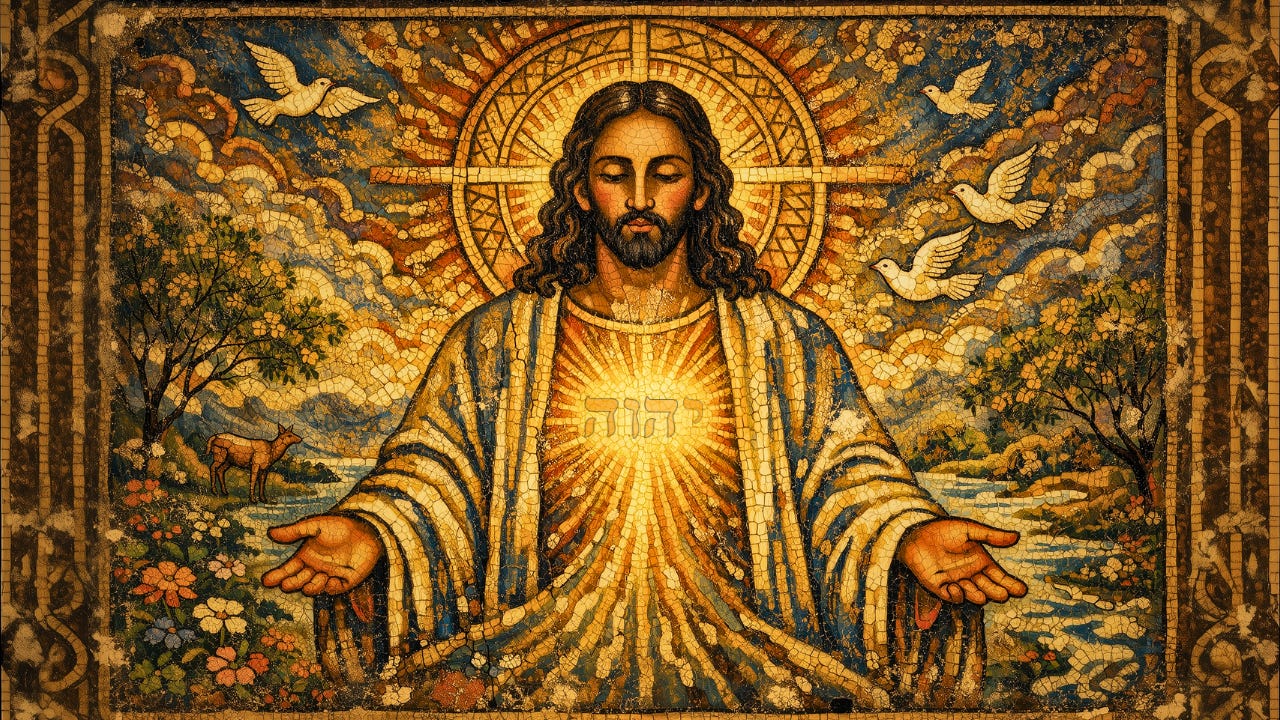
Names and the Power of Relationship
Names have power.
Think about when your parents were mad at you and they said your full name. You snapped to attention because you knew you were in trouble. Think about the nicknames and other things that your friends call you, and only your friends. Think about the names you call yourself in the quiet hours of the night when no one else is there to listen.
Names have power, but that power is a strange magic.
Names define the relationship that you have with others. What you tell someone to call you, and what they actually call you, and that you allow, shows how familiar you are with each other. When they deviate from those agreed-upon terms, it shows a change in the relationship. Maybe a temporary one, but maybe a permanent one.
We don’t often consider the relational power of names. But the topic is inescapable as we meditate on the Most Holy Name of Jesus.
When Names Become Tools
In social settings, we can see how people use the power of names to forge or sometimes even force relationships that they wouldn’t have normally. When you want to talk to someone across the room, it’s not uncommon to ask those around you, “Hey, what’s their name?” That’s because, in using their name when you first meet someone, you are exercising a certain power in the relationship. You’re saying, “I already know you. You should know me.”
That is using a name like a tool.
In many magical traditions, names are used in this way, where the simple repetition or invocation of a name grants a certain amount of power and control over that entity. Some traditions go so far as to say that everything has a secret name, and once you know that secret name, you have complete and utter control over them.
In the ancient Near East, names functioned in a similar way. To place the name of a deity upon an object was to invite the presence of that deity there. If you placed the name on a stone or an idol, you were inviting the presence of the deity to be there, and thus exercising a certain degree of control over that deity by doing it.
To take the divine name upon yourself would be to invite that deity to indwell you and to give you the right to access its power and domain in this world.
We see this in the angel that was sent to guide the Israelites. The angel had the name of God upon them and thus could act in the person and power of God. We see this in the Temple and the Ark of the Covenant, which also operate with the reverence, power, and authority of the divine.
So when we receive the commandment not to take the name of the Lord in vain, we are being told not to misuse the divine name. To be careful in how we are representing the divine or trying to utilize it in our lives.
Instead, we substitute names like Adonai, HaShem, or HaMakom. This act of restraint shows our reverence for the One named and invites the relationship that we are seeking with Them.
The Name Given, Not Taken
We see this logic of the Name appear several times throughout the Gospel stories.
When the angel meets Mary, he bestows it upon her: “HaShem is with you.”
We see this at the baptism of Jesus by John the Baptist, when a dove descends and the voice cries out, “This is my beloved Son, in whom I am well pleased.”
That relationship of father and son is the way the divine name was communicated in the Davidic kings and in the line of Omri. The stories do not present Jesus taking the Name, but being given it. It descends upon him because of his life of faith and the way that he interacted with all who were around him.
Through that life, Jesus reveals what it means to bear the Name.
In the high priestly prayer of John’s Gospel, Jesus says that he has shown us the Father so that when we see him, we see God.
John 17:21-23
21. that they may all be one; even as you, Father, are in me, and I in you, that they also may be one in us; that the world may believe that you sent me.
22. The glory which you have given me, I have given to them; that they may be one, even as we are one;
23. I in them, and you in me, that they may be perfected into one; that the world may know that you sent me, and loved them, even as you loved me.
To Jesus, to bear the divine name was to be a mirror of the divine.
If we are going to take up that Name, we must have the same hospitality and grace and blessing that flows from the Holy One.
Jesus makes this clear in Matthew 25, where he tells us what it means to actually live in the kingdom: to take care of each other, to heal one another, to make sure everyone is safe, secure, fed, and homed, and not left lonely.
The radical message of Christ was that the kingdom of God is already here, not alone, but wherever two or three are gathered in his Name.
Paul and the Name Embodied
Paul gives voice to this mystery when he tells us that the Name given to Jesus is above every name, that is HaShem, so that when we hear the name of Jesus, every knee should bow and every tongue confess that Jesus Christ is HaShem.
Philippians 2:9-11
9. Therefore God also highly exalted him, and gave to him the name which is above every name;
10. that at the name of Jesus every knee should bow, of those in heaven, those on earth, and those under the earth,
11. and that every tongue should confess that Jesus Christ is Lord, to the glory of God the Father.
This is the Name embodied.
The holiest Name, the Name God uses for God’s own self, is given to Jesus. And so when we say the name Jesus, or take on the name Jesus, or hear the word Jesus, the Name of God indwells it.
This is not a statement about domination. It is a call to recognition.
It is an invitation to see the indwelling Name inside the One we follow.
We do not bow because we have to. We bow because in this moment we see that God is in Christ and Christ is in God. The holy Name that animates the universe, the Holy One, HaMakom, is the kingdom spreading throughout the cosmos.
Empire twisted this language to say that people should bow to them. But what Paul is really doing is helping us see like Moses before the burning bush.
This is holy ground. Take off your shoes. Touch it. Let that ground of being flow into you, around you, through you.
You are standing in the presence of Ehyeh Asher Ehyeh.
In the presence of Being itself, what can one do but bow?
What Becomes Impossible
Once we see the Name of God indwelling Christ, we learn not to put too much faith in pastors, churches, or anything that claims ultimate authority.
Christ is our teacher and our high priest. We bow before the cosmos itself, before the One Life flowing through all things.
Grace does not require an earthly intermediary. It abounds in all things as it always has since the beginning of the world.
Blind obedience no longer makes sense. Groupthink dissolves. In-group and out-group dynamics lose their power.
Christ is the One who sustains and maintains the universe, through whom all was created. And as such, that divine wisdom prevents us from seeing anyone as other than ourselves, because we are all in that One Life.
We were all made from one flesh. We arose through a marvelous process of evolution, mutually growing and changing together. Diversity is the point and purpose of life itself.
Uniformity and conformity become unthinkable.
We learn to live in a new relational way, recognizing mutual indwelling and the grace that exists between all of us.
Prophetic Sorrow for a Broken Name
I grew up in evangelical Christianity, where I was taught to fear God, not to stand in awe.
There was no wonder in the relationship I was encouraged to develop. I was taught original sin, that I was intrinsically broken and flawed. That use of the Divine Name, clinging to authority and control, has harmed society in ways we are not yet ready to quantify.
I remember my great-grandmother receiving letters from a televangelist, written in the prophetic voice, claiming to speak in the Name of God and Christ, telling her that if she did not give more than she had, she would go to hell.
Misuses of the Name like this have brought trauma and pain where there should have been wonder and awe.
These preachers of death corrupted a message of love and solidarity and turned it into a system of fear, greed, and control. It is easy to understand how people lose faith entirely.
I lost mine for a while.
Only when I found the right relationship with the Name did I begin to come home.
The Name as Refuge
That return began when I learned that everything is prayer, that our entire lives are living temples, that God is not standing over us but dwelling with us.
The Holy Name is Being itself.
Deuteronomy 6:4
4. Hear, Israel: Yahweh is our God. Yahweh is one.
The word one is Achad, which means one, unified, or without division.
In time, I became fascinated with the Mughal Emperor Akbar and the movement he founded, Din-i-Ilahi, “The Way of God.” At its heart was a simple confession:
Your Name is a fortress, and you are its foundation.
There is no God but God.
The Name is Being itself. I Am That I Am. Being is the fortress in which we live, and God is its foundation.
I still find myself praying these words, especially on the Feast of the Holy Name. If they resonate with you, I invite you to take them up yourself. If they do not, I invite you to meditate on what it means for a Name to be a fortress and a foundation.
Blessed is the Holy Name HaShem, which resides in the Holy Name of Jesus, which resides in the hearts of all who believe and follow him.
This is what it means to be a true tabernacle of Christ in the world.