


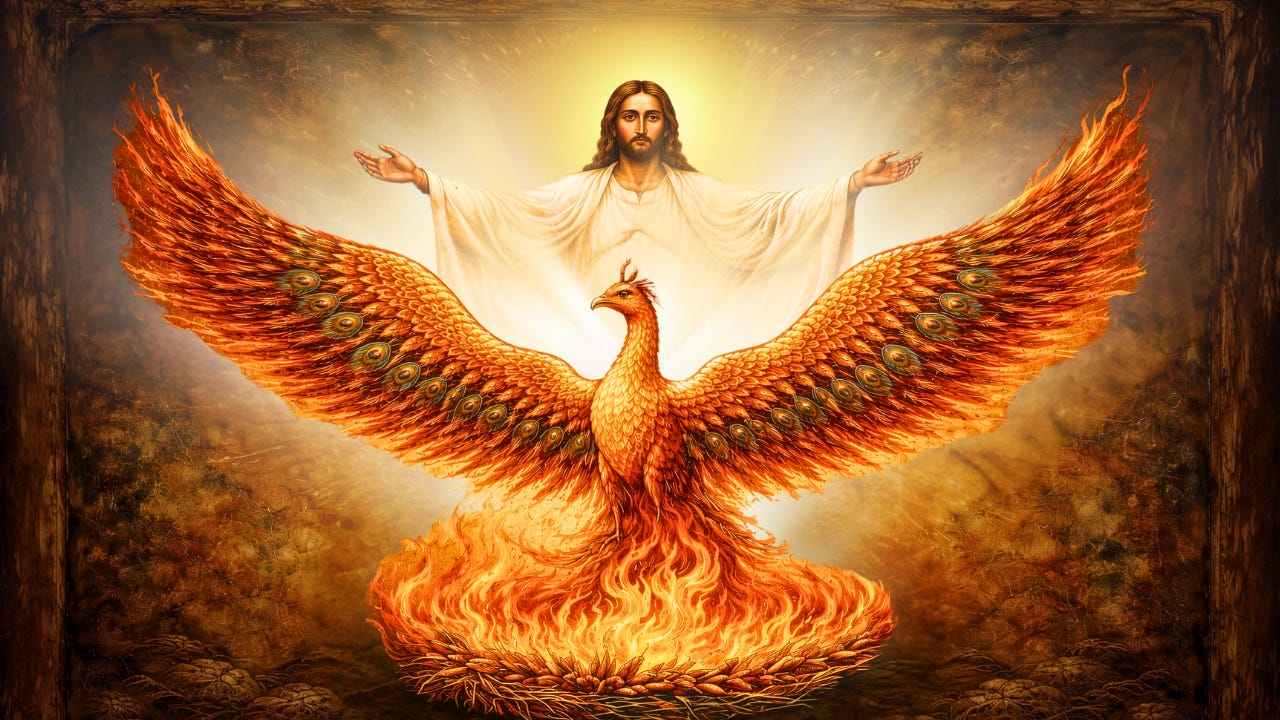
The World as Scripture
In the wonderful song Word of God by Leslie Fish, the chorus sings, “Man wrote the Bible, God wrote the rocks.” The real power at the heart of any spiritual tradition is to learn to read that word written into the stone, into the trees, and the wind blowing through the grass, and the song of birds, and in the life that we are living.
In the first path, we learn to behold it with awe, wonder, and delight, and how to savor it. In the second path, we learn how to make space for whatever may come. Here in the third path, the way of creativity, the Via Creativa, we learn how to read the world through our imagination. We learn how the world speaks and how we can interpret it for ourselves.
Our imagination has so many more uses than just daydreaming and telling beautiful stories. It is a way of learning through finding the right words and images to express the relationships we have with ourselves, with the people and creatures and things around us, and with the whole vastness of the cosmos itself. It is in our imagination that all of our relationships live. After all, that’s where the stories we tell ourselves and the stories we accept roam free.
Throughout our day and throughout our lives, we modify and we change those stories. Sometimes we even feel trapped by them, telling the same story to ourselves over and over again in a way that’s not helpful. In learning to see this imaginative process as a way that we both interact with and glean insight from the world, it becomes a powerful tool, a spiritual technology that we can use to reach out and see beyond what our words can touch. This is exceedingly helpful the more complex the relationship is that we’re trying to wrap our heads around.
Carl Sagan, in trying to get us to understand our relationship to the cosmos, said, “We are made of star stuff.” That image grounds in our bodies our relationship to everything in the great vastness of space.
In the early Church, Clement of Rome used the image of the phoenix to help us understand resurrection and the life of Christ. It is an image that we have lost, but one that has so much power to it and reveals many wonders that we should take a look at again with fresh eyes.
When you think about the phoenix, many images might arise within you. To many of us, it’s a mythical bird or creature that we encountered in a fantasy novel or movie. When Clement invites us to see the phoenix as part of this great Christian mystery, he is opening us up to realize how we can read the mysteries of the gospel.
What preconceived notions arise when you think of the phoenix? What does it embody? What does it mean? Just its very nature, a bird that burns itself to ashes to be reborn again from them, that image of the phoenix is the gospel story in brief. Even more than that, it is the mechanism by which life and creativity flow.
What if we allowed ourselves to see that bird of fire rising from its nest yet again, deep in our mind’s eye, deep in our hearts, that place where we tell ourselves the stories about our lives? What would it mean for us that the phoenix is there? What could the phoenix teach us about how we live in this world and how we relate to it? Could it even possibly help us to understand where we are in our own life cycle, and if we are about to fly from the nest or burn to ash to rise again?
The Phoenix in the Early Church
When we think about the early Church, especially in the time before it gained imperial sanction, and even in the time afterwards, there is a difficult imaginative practice happening. The gospel was born in the Galilee. It then spread out into Judea and the surrounding areas. Much of those places shared a common mythos, a common language family, and a common set of metaphors and ways of understanding the world.
When the gospel permeated Europe, it met a bunch of new challenges. The ideas of Aristotle and Plato, and the Neoplatonic thought that was rising at this time, and the Middle Platonic thought that was everywhere. This is why we see so many varieties of Christianity in the second century and those that follow. These were all attempts to take this intrinsically Jewish understanding of life, how we should live it, and the person and figure of Jesus Christ, and translate it into something that could operate within this Greco-Roman way of thinking.
This work of translation required more than just changing the words from one language to another. It required them to be able to sustain the embers they contained within an environment that was very different, in a landscape of the mind that did not have the same things growing in it. Instead of conforming their thoughts and attitudes to the one that had been presented to them, they planted it in new soil so that it could evolve and change into something different, something that could live in this new mindscape.
They did this through syllogism and argument, through apologia. They also did this through the use of metaphors that helped them grasp ideas more easily. You can really see the difference in this translation style when you look at the form of Taoist Christianity that arose in China, as it did the same practice but with a whole different mental landscape to grow in.
In both of these streams, mythology and symbolism were necessary tools of the creative imagination to glean understanding in ways that they could understand within their own cultural framework. We still do this today.
For Clement to call on the image of the phoenix evokes the symbolism of what it means. The bird that lives, dies, and is born again is a natural fit for the Christian message. It also sets our minds to think that this is not something close to us, but something a bit more exotic and elusive. The phoenixes, after all, live in the Arabian desert.
In many ways, when Clement brings up the image of the phoenix, it is a way to help himself and his readers understand that this wisdom, this energy that they are importing into their lives, is something foreign and exotic, while simultaneously trying to bring this new wisdom into its own set of metaphors to plant it in this new soil. It’s trying to plant this little seed to remind us that the story did not arise in our own context and thus we should return to the original image.
The metaphor speaks to the process of what is going on. We collect in the nest what we can, what is available to us to help us to understand. Then, when the fire comes, what we don’t need anymore is burned away, and what remains is incorporated into the new bird as it rises out to start collecting again. The phoenix not only helps to explain the gospel message but shows the process by which we incorporate it into our lives.
Christ and the Phoenix
When we connect the image of the phoenix to the life of Christ, the metaphor opens up, and we see that it’s attached in two distinct places. We see the phoenix being invoked by the Church Fathers with the Incarnation and also with the Resurrection.
The phoenix bursts to new life in both of these scenes because this is the revelation that these are both the same. The birth of Christ, while a momentous moment for our faith, is not the first time God has indwelled the world. God has indwelled the world since the very beginning.
The Resurrection, then, is not the true revelation of God. It is the process continuing. Because life, as a certain character says, finds a way. Even through calamity, through pain, through suffering, and even through death, that energy, that life, that one unifying existence that we find in Christ finds a way to continue and breathe life into the world again.
We see the phoenix again and again, bursting into new life. That’s the same process we see in deep time and in our own lives, as we are renewed over and over again, becoming new people at various stages of our lives. All creation participates in this divine renewal of incarnation and resurrection and the great span of life that stretches out between them.
Sometimes these fires erupt in us without prompting. Maybe it’s through a momentous life change. We all experience them in puberty, when the child in us is consumed and the teenager is born. This is not a moment. It’s a process. It is a fracturing that happens again and again as we undergo these changes.
The teenager will, at some point, be consumed back into ashes so the adult can rise. That adult will go through many changes. There are many changes that I have skipped over because there are too many to name. This process of change is the process of life itself.
We live within it. We bear it in our souls. We can also consciously cooperate with it through our imagination and creativity, allowing us to bring the changes, to collect and build the nest, and cause the fires to bring new life in us.
Via Creativa and the Pattern of Renewal
This is how the Via Creativa, the creative way, helps us to learn and to understand, to have access to things that sometimes are beyond words.
In Path One, we gathered all that we found to savor. In Path Two, we made space within us. But here in Path Three, it is time to arrange them and build that nest, so that when the fire comes, all that is no longer needed is burned away, and we incorporate all that is new into ourselves.
This could be in telling ourselves new stories, in producing new art, in conversations that we have one with another, or through deep actions in meditation. In truth, it doesn’t really matter which path you take, as long as the stories are constantly being renewed and refreshed and allowed to breathe and have their own life.
The art of the Via Creativa is to learn how to learn through this imaginative process. We’re not making things up. We are finding ways to interpret the relationships that we have, even the ones that are hard to speak about.
That’s why we have an almost infinite playlist of love songs. Love is a relationship that is hard to put into words because it sits and lives just beyond them. So every experience of love tells its own story. It exists in this divine imagination within us so that it can breathe and have new life.
This is also how relationships are harmed. When something enters the story that was unexpected or unwanted, what happens next is heavily dependent on how we reinterpret it into the story. Does the person that we learned this new thing about become something that is discarded when the fires come, or is the relationship reforged in a new way that recreates and renews both people in it?
That is the difference between a relationship that endures hardship and one that fractures because of it. It is all about how that relationship exists within the imagination, in the story that we tell ourselves. That does not mean that one outcome is right and the other outcome is wrong. There is no universal rule that can be applied here. It really does depend on all of the constituent components and how they are arranged and brought together.
So it is with all of life. It’s in this burning forge of our imagination that we tell and retell these stories, either connecting ourselves and rooting ourselves further into stories from our past, or cutting them off and letting them die away and telling new stories going forward.
Sometimes it’s simple and easy. Other times the stories are rooted in so deep it is hard to get them to let go. But once we realize that our imagination is this vibrant way of knowing, then we can use it to the best of our ability, feeding it all that we can that is true and good, to help what arises next will be better.
The Nest of Myrrh
When Clement describes the phoenix as gathering frankincense, myrrh, and spices to build its nest, it’s bringing the most fragrant, powerful, pungent spices, the ones that can be savored. This is a reminder of our work in the first path, to find what brings awe, wonder, and delight, and the things that we can savor.
Arranging them in the nest reminds us that the nest has a hollow in it. So we are reminded of our work in Path Two, to find an open and spacious place where whatever arises can come. These two stages are vital if we want to truly embrace this creative power.
This is what it means to be willing to trust our images enough to birth them into reality. That trust is a kind of final gut check, that we have gathered everything that we need. But it’s also a trap if we’re not careful.
Notice that qualifier there. Everything that we need, not everything that we want or everything that we could have. We will build another nest later. We don’t have to have everything now, just enough to trust that the process will work.
Learning that kind of trust takes trial and error. It takes experimentation. But if we never allow the phoenix to burn, never let our imagination try to reach out and tell us what all of this is trying to say, then we will never learn if we have gathered the right things and strengthened within ourselves the skills to gather what is needed in the moment.
This is not surrender. Surrender happened in the Path Two. This is not consent. Consent happened in Path One. This is trust. Trust in ourselves that we have done what we need to do, and trust in the cosmos that it will not lead us astray, as long as we are following truth and compassion and justice. Those guide stars will help us to find all that we need to gather, so that when the fire comes, what arises will be stronger and better for it.
The Phoenix as Creative Practice
William Blake calls Christ the Divine Imagination. In the Via Creativa, we are called to be co-creators with God in this world, to come to see God as both our child and our mother.
When we practice this art of the phoenix in the Via Creativa, what we need to realize is that this cycle is always at work within us. It names both our desires and our fears.
Our desires and yearnings, the things that call us out into trying to find meaning in relationships, are the very drives within us to gather the materials for the nest. Our fears, those things that block us, are those concerns of, “Have I built the nest properly? What happens if something goes wrong with the fire?”
We can see this action all throughout our lives. Think about the first time you looked at somebody and you wanted to have them in your life, whether as a friend or as an intimate. You sought out examples. How do you talk to somebody that you don’t know? How do you get to know somebody you don’t know? How do you get them to know you better? In this, you built the nest.
You might have worried that you didn’t have enough information. What would even happen on a first date? What would we even do if we decided to go hang out? What would we talk about? What if they say no?
The fire comes in once you have the courage to strike the match, to actually go up to them, to talk to them. It really does feel like you’re burning from the inside, all that anxiety and energy just burning and boiling within you. The excitement of possibility and the fear of rejection. But you committed, and you did the thing.
Now the fires have burned, and the new phoenix is born and sees what world it has stepped into. Like all things in this world, it’s one where consent matters. You did your part in telling the story. Now it’s their turn to either yes-and or no-but. That sets the story going forward.
We can see this in other parts of our lives too. That job that you want to apply for. That school that you wanted to go to. These are all little fires that burn within us, where we go through the same process of gathering in and then taking that step through the threshold where everything will change. Nothing will be the same on the other side.
After all, what happens if you go to your dream destination and it doesn’t live up to the hype? You can only learn that by going.
This kind of creative process never really ends in failure, though it often feels like it does to us. That doesn’t mean that we made a mistake, and we’re not being punished for doing something wrong.
We have to understand that the mythic storytelling that is the nature of all relationships in this cosmos is akin to improv. It requires consent from all parties to participate. While it can feel hard to do, we have to recognize the agency of the other to say no. After all, without consent, there is no relationship.
Not getting what we want can hurt, but the knowledge is better than the eternal yearning that would prevent us from going out to seek something different, something new. After all, the point of this life is to be ever renewed, like the cosmos itself is.
When disappointment, grief, or endings arise, we enter back into Path Two, where we have made space, where we know that pain is a real part of our lived experience, and we sit with it, tend to it, and help it to heal.
An Invitation to Rise
I offer you this image and practice of the phoenix, not to give you one more thing to do, but as a way of seeing something that you’ve been doing all along. It is a way of naming a relationship that we have with our lives and seeing its constituent parts.
I invite you to try it on. See if it works for you. If it doesn’t, that’s fine. Find one that does. There are many ways to imagine the creative process.
This is one that I have found particularly useful in my own life because, well, that fear of striking the match and getting the fire started is one that I experience regularly.
Practice in the Via Creativa is all about learning your relational models. What maps onto your experience best, and how can you use those relationships, those mythic images, and metaphors to help you see more clearly the way you are living your life and how you can improve it and make it better, to find life more abundantly.
A Prayer for the Fire That Renews
O blessed Christ, who burst forth like the phoenix at the first flaring of the cosmos, and again and again throughout time, who arises in Bethlehem to our Mother Mary and repeatedly reveals your glory throughout your life, and even in your death, burial, resurrection, ascension, and the sending of the Holy Spirit down upon us, which is envisioned beautifully in the book of Acts as tongues of fire.
Open our eyes so that we may see this process of birth and renewal as it is constant throughout our existence. Help us to live with it in peace.
O blessed Word of fire, awaken within us a light that cannot be dimmed by this world or by any of the experiences that we have within it, an eternal flame that always seeks truth as we live it out in the relationships that we have with ourselves, with one another, and with the cosmos.
Blessed Artist of Resurrection, help us to see the possibility of new life in every ending, and the way that life can go on when everything feels still and empty. Help us to see the world always new and renewed with the eyes of a child, never complacent and never bored by the endless wonder spanning all that is around us.