


O Blessed Epiphany
O blessed epiphany that unveils the wonder present in the world.
O holy epiphany that teaches us to recognize the awe present in all things.
O sweet epiphany that invites us to come home and to find the light, word, and wisdom that has been calling us since before the beginning.
We arrive at Epiphany when things snap into place. Suddenly, we realize something that we hadn’t before: that the world is filled with grace and created in original blessing.
We are enraptured by awe in the rising and setting of the sun, the beauty of the valleys, the vastness of the oceans, the majesty of the mountains, as we gaze upon the infinite scape of stars in the heavens and in the tender moments of our relationships with one another. Throughout our lives, we encounter millions of places that open themselves up to this blessing. The food we savor, the sweet aromas that make us smile, a joke spoken that makes us laugh, a wise word said that breaks us into sudden realization that it is good.
As Julian of Norwich says, “All shall be peace.”
This epiphany is a threshold, and one that we choose to cross or close the door on, and wall ourselves off from it.
Awe at the Threshold
Awe, in its purest and clearest form, fills us equally with a sense of fear and wonder. When we gaze at the vastness of the night sky, we can feel how small we are while wondering at all that might be out there.
Sometimes that fear triggers something in us, and we fall into fight, flight, or freeze. Perhaps something in our experience has taught us that this kind of awe is not for us, or that it is something that only a certain kind of people, not us, experience. And so we fight it. We push back and argue against it. Awe is just a cascade of chemicals in the brain. We deny the wonder within it and refuse to savor it, and turn our backs and walk away.
Sometimes we are overwhelmed by that fear or wonder, and we run, we flee. Maybe because we think we are unworthy or undeserving, or because it feels like it’s just too much. We can feel overwhelmed by this awe and turn our backs on it.
At other times we freeze, and this is the most dangerous one of them all, because we can convince ourselves that we are so enraptured by it. What is there to do but embrace the stillness?
But awe, wonder, and delight are invitations to savor, to draw in, and to move into, whether mentally, spiritually, or physically. Just standing there, refusing to cross the threshold, keeps us from truly experiencing it.
Aliveness Revealed
When we allow ourselves to cross this threshold and enter into that awe, wonder, and delight, and to truly savor it deep down within us, we experience for the first time, or the next time, the experience of really, truly being alive.
Aliveness is participation in life, in the cosmos, in the world around us. It is more than a state of existence. It is not just being alive or dead. It is about entering into the vast web of experiences and relationships that are available to us.
Through them, we find meaning and purpose, not the other way around. Meaning and purpose arise from doing something that we feel matters, that we truly believe matters. As we cross that threshold and allow ourselves to savor this aliveness, we are called to continue on the path to discover life more abundantly.
The Advent Gospel of Creation Spirituality
This is the Advent Gospel of Creation Spirituality: that all things are made good in original blessing.
The cosmos is defined as much by how it cooperates as how it competes with itself. In those endless cycles of creation, complementary action, and competition, all life, all things come into being. This balance and harmony of the cosmos invites us to see the world as good. As the book of Genesis puts it, as very good.
Good, Not Perfect
When we recognize the world as good, we are not saying that it is perfect. A perfect world is incapable of change. Nothing can change in perfection. Any deviation that would arrive in a perfect system would set it out of balance and distort its perfection.
When we realize that the world is good but not perfect, that is not the same as saying that it is imperfect. Pain, suffering, and change occur within it, and that is a real and valid experience in this life.
It is hard, and it is almost impossible for us to recognize any of these things as good, because we want to live in that blessed state of pure happiness and joy where no sorrows can reach us. But that world would be hollow. It would lack any ability to grow or change. It would lack the ability to experience surprise.
So many try to craft a reason for why pain, suffering, or bad things happen to good people. They happen because bad things happen to everyone, to everything. As Jesus puts it, “The rain falls on the just and the unjust alike (Matthew 5:45).”
Rain is how the earth is renewed, how nutrients are drawn down from the sky, and how various processes are allowed to continue. It is part of the system. It is the mechanism by which the atmosphere brings itself back toward equilibrium. Sometimes that brings storms, floods, and fires, and with them, suffering.
If there were no need for the system to balance itself, and everything existed in a state of perfect harmony, nothing could grow. Nothing could live. Everything would exist in a fatalism where all aspects of existence are already predetermined.
The cosmos is good. Chemical processes can happen. Plants can grow. Animals can live. Stars can be born, live, and die. And so can we.
Because the world is not perfect, we do not have to accept any of that as final. We merely recognize it, and know that throughout our lives and our work, we can perfect what is good into something better, the new good that will need its own perfecting.
Original Blessing and the Human Person
When we recognize that we, like the cosmos, were created in this original blessing, we too were created, or born, good, not perfect.
We are each a unique manifestation of the cosmos as it is trying to understand itself. Each of us will see it differently, experience it differently, and act within it in our own unique ways. That diversity is our strength.
But more than that, we are not individuals, whole and solid in and of ourselves. We are dividual beings containing within us a multitude of persons. We see this in our actions, how we behave when we are angry or sad, in pain or in joy.
Some of us have internal editors that speak criticism to us, while others have internal daredevils that urge us to go out, take risks, and try new things. All of these things make us who we are and what we are, and they are good but not perfect.
What is good can always be made better. We do not have to end where we began.
God Who Dwells Within and Among Us
Once we recognize our aliveness and the gifts that it brings, we have seen our first glimpse of the divine.
God is not an old man in the sky, nor something foreign to us. God is the ground of being in which we live, move, and have our being. God is in us, and we are in God.
As we learn to participate with our own aliveness through our relationships with ourselves, with others, and through the connections we have to the world, we are, in fact, living God into the world.
We find God in awe, wonder, and delight, and in the art of learning to savor it. We find God in those parts of us that open up, sometimes through cracks or ruptures, but other times through mindful, deliberate action, to embrace the diversity of life and the experiences that are in it.
God is there with us in pain, sorrow, and grief as much as in joy and delight. We find God in creativity, in learning to live in these relationships in new and imaginative ways.
We come to understand that we are as much God’s child as God is our child. Through our relationships, we learn to trust the images within us, to ride them into reality so that they can be born.
We learn which passions we can follow and trust will lead us on the right path, the good path, toward joy, awe, openness, justice, and celebration.
We find God in justice and justice-making, in the path that reminds us that we can always return to the way through the act of teshuvah, repentance, the changing of mind and the returning to the way.
God is also there in our attempts to repair the world, to bring greater perfection to it, which is called tikkun olam, the reparation of the world.
Every time we find awe and wonder in this world and open it up so that it can be delighted in and savored, we are releasing that light into the cosmos so that it can rejoin the whole.
God is lived. We pray through our lives, through our words, through our actions. We are the temple of God. The earth is the temple of God. Every person that we meet, everything that we encounter, is a temple of God.
God is a verb, an action, a process that is always becoming. And through living God, or God-ing, we become co-creators of this world.
The Star and the Four Paths
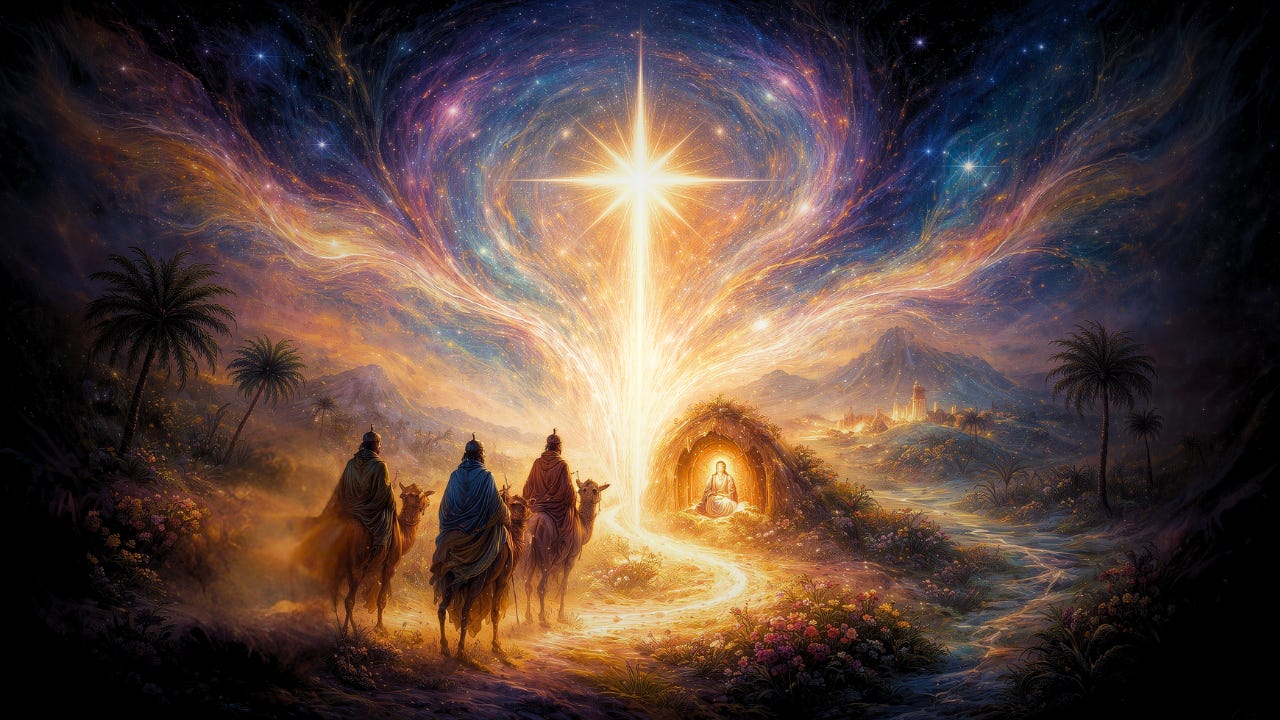
In the story of the Magi, we see how we walk the four paths.
First, we see the star. The star is that awe, wonder, and delight. That invitation into the Via Positiva, the positive way, the first path. Throughout our lives, we will see many stars. Many fascinations will arise, and in them we will find awe, wonder, and delight.
The work is to learn how to savor them, how to welcome them with cosmic hospitality, and how to live with them in right relationship. When something comes into our lives and we sense that awe, wonder, or delight, we have seen a star in the heavens. That is how we feel it. That is how we know we are called, and that it is time to take the first step onto the path.
After the Magi have seen the star, they leave where they are. This leaving is the second path, the Via Negativa, the negative way. On this path, we learn how to be spacious, to open ourselves up so that we have room for all of the things that we experience, whether awe and delight or pain, sorrow, and grief.
This openness reminds us that we are engaging with a vast diversity of experiences, just as we encounter the diversity of the cosmos itself. There is not one kind of star, planet, plant, or animal. There are many, and each is different in its own way.
In this second path, we learn to let go and let be, so that grace may flow in, around, and through us. Without that spaciousness, we cannot savor fully, and neither can we grieve and heal.
When the Magi arrive where the star has led them, they offer gifts. In the story, these are gold, frankincense, and myrrh. In our lives, this is learning to trust the images within us so that they can have life in this world.
This is the Via Creativa, the creative way. Here we learn to use imagination not merely for daydreaming, but as a tool for understanding, for giving rise to new metaphors and new ways of seeing.
Creativity is the gift that we give. Through this mutual indwelling, we come to know that we are as much the child of God as God is our child, and through our actions, words, and thoughts, we are birthing God into the world.
This is not a burden. It is recognition of a process we have always been living.
The Via Creativa invites us to bring the savor we learned in the first path and the mindfulness we developed in the second path into compassion. There we learn to live imaginatively, mindful of the real world we inhabit, and with compassion for ourselves and those with whom we live.
After the gifts are given, the Magi return home by another way. This is the Via Transformativa, the transformative way.
As we develop savor, mindfulness, and compassion, we stretch outward into the world and move forward already changed. Through imagining relationships as they could be or should be, we may see ways we need to correct in ourselves or in our society.
Here the arts of teshuvah and tikkun olam come into play. The fourth path teaches us justice-making in celebration. When we imagine something better and change our minds and our ways to live it, justice enters the world more fully.
Those things we have savored, made room for, and imagined into being must be celebrated.
A Word to the Weary and Wounded
Life can distract us from this recognition and blind us to seeing it. We can work so hard that we no longer have the energy to look up. Illness can wear us down and leave us tired all the time. Circumstances can leave us lonely and wounded.
Many of us come from religious traditions that did real harm and trauma to us. All too often, we have accepted other people’s stories that we are not worthy and do not deserve good things.
I know those feelings well. They give birth to hopelessness, fatigue, and isolation that are hard to move through. It is like walking through a dense fog, unable to see the path ahead or behind because the cloud is so thick.
We are not failures for feeling this way. It does not mean we are unworthy or undeserving. It means we have been ground down by systems of control and coercion that have dominated our lives and prevented us from living on our own terms.
I am here to tell you, from experience, there is a different way.
What the Way Is and Is Not
The way is not a system of rules that must be followed. It is not a threat that if you do not follow it you will be forever lost. There are many paths that lead back to the light.
None of them bring healing and restoration immediately. All any of us can do is invite others to look up and see the light.
Ask yourself, where do you find awe, wonder, or delight? It could be as simple as your favorite chocolate. It could be as profound as a hike to a secret place in nature. It does not matter.
All that matters is that you know where awe, wonder, and delight live for you. That is enough.
Whether we are lighting a candle or a bonfire, we are still bringing in the light. Through that light, we can see where we are and the path before us more clearly.
Just as the world is good but not perfect, the way is good but not perfect. Each of us has our own unique first step onto the path.
The First Step
The first step on the path is simply seeking awe, delight, and wonder that we can savor. That is enough.
The way meets us exactly where we are and does not ask us to go somewhere else right away. First, we must see the star in order to follow it.
When you are ready, place yourself where awe, wonder, or delight may arise. Start small. Savor it. Taste it.
See that the Lord is good. See that the world is good. See that life is good.
Once you recognize original blessing, even in the smallest thing, the path is open. Grace is everywhere, filling the cosmos and stirring it to action.
You may find it in the arms of our Blessed Mother Mary, or in another way. But you will find it.
Then you will have taken that step into the greater, wider world. You will hold the Divine Child in your arms for the first time and perceive original mind, even if only a glimpse of that mindful compassion at the root of all being, that place of joy and mystery.
In time, you will feel the presence of the Holy Spirit, that animating force within us that calls us to seek wisdom and to grow and nurture it.
The seed of the Tree of Life is planted in all of us. All we must do is tend it and help it grow. As it matures, we will find life and find it more abundantly.
A Blessing for the Way
Blessed be the One from whom all blessings flow.
Grace upon all who wander this earth, with mindfulness and compassion to guide us.
We will one day learn to walk without walking and enter the paths more fully, walking all four as a great spiral dance toward a better and greater world to come.
O blessed wisdom, enliven our minds so that we might see the glories kept hidden from us and just beyond view, so that through awe, wonder, and delight, we may learn to savor this life, opening ourselves to it and all the diversity it contains, so that through imaginative relationships, we may bring justice and celebration to the cosmos.
Amen.