


A Devotion for the Feast of St Stephen
Acts 7:55-56
55. But he, being full of the Holy Spirit, looked up steadfastly into heaven, and saw the glory of God, and Jesus standing on the right hand of God,
56. and said, “Behold, I see the heavens opened, and the Son of Man standing at the right hand of God!”
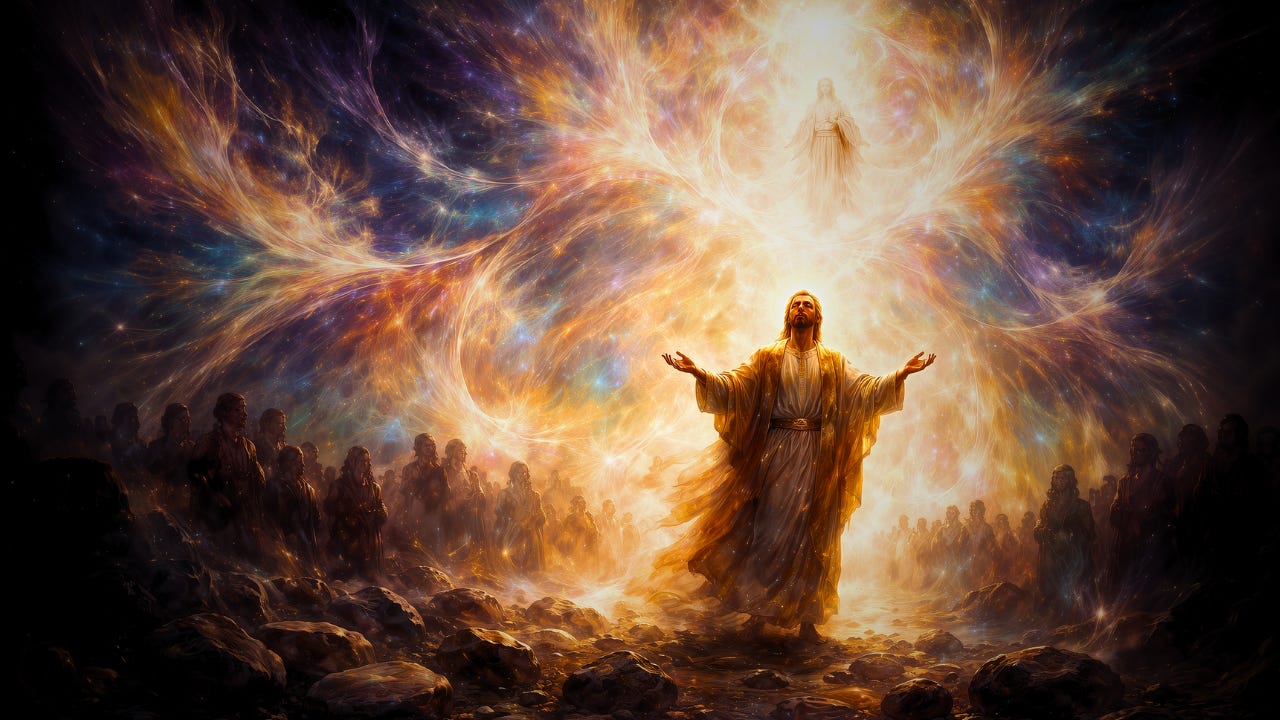
Stephen lay on the ground, bloody and beaten, one hand reaching up toward the heavens, which had parted. He could see the one his heart desired and next to him, on his right side, he saw his Lord Jesus Christ.
Stephen was dying. He knew that his time was short. And yet he whispered a prayer that the people who were killing him would be forgiven for what they were doing.
What happened to Stephen reveals what happens when the Incarnate Word is spoken aloud in a world addicted to control. It is the consequence of certainty meeting hope. Certainty is always ready to cast stones. Hope just wants to get the job done.
This is a dark story for the day after Christmas. It sits uncomfortably close to the manger. Yet it is still a story about incarnation, about the One Life flowing through a Hellenistic Jew who had been commissioned to ensure that the poor and the needy had food, money, shelter, and care. It is the story of a man who was stoned for claiming that God does not live in buildings built by human hands, but is present everywhere in the world.
The Mutual Communion With God
Acts 6:3-5, 8
3. Therefore select from among you, brothers, seven men of good report, full of the Holy Spirit and of wisdom, whom we may appoint over this business.
4. But we will continue steadfastly in prayer and in the ministry of the word.”
5. These words pleased the whole multitude. They chose Stephen, a man full of faith and of the Holy Spirit, Philip, Prochorus, Nicanor, Timon, Parmenas, and Nicolaus, a proselyte of Antioch;
8. Stephen, full of faith and power, performed great wonders and signs among the people.
We do not know much about Stephen before this event. In fact, we do not even know if Stephen was a historical person or a character shaped by the community to tell a deeper truth. What the story tells us, and all that the story insists on telling us, is that he was filled with the Holy Spirit.
Stephen is living this mutual communion with God, this incarnate communion, where he sees the presence of God in all of the people he is meant to take care of. The Book of Acts tells us that the early church gave everything to the collective, and then redistributed those resources to ensure that everyone was cared for.
This is a vibrant story. It lives out the teachings of Jesus rather than merely repeating them. We are here to take care of the poor, the hungry, the thirsty, the sick, the infirm, the widow and the orphan, the imprisoned, and the refugee.
The role of the deacon was not to enforce doctrinal rigidity. It was not to preserve institutional authority. It was not to ensure harmony by suppressing conflict. The purpose of the deacon was to make sure that everyone was taken care of, that the grace meant to be poured out through collective care was available to everyone.
Stephen is portrayed as a perfect example of this grace. He insists that God can be found outside the temple precinct. He insists that God can be experienced wherever he is and in whatever he is doing. And he insists that everyone else can do the same.
God is everywhere. God is the one in whom we live, move, and have our being.
In this story, we see Stephen taking care of that manifestation of the divine in all of its places. We see him defending a vision of reality that insists that God is everywhere.
God Is Everywhere
Acts 7:48-49
48. However, the Most High doesn’t dwell in temples made with hands, as the prophet says,
49. ‘heaven is my throne, and the earth a footstool for my feet. What kind of house will you build me?’ says the Lord. ‘Or what is the place of my rest?
Stephen’s speech is sometimes interpreted as anti-Semitic, and it has certainly been used in anti-Semitic ways. That misuse is a grave distortion of the text. What I actually see here is a person struggling to define the role of God in the world, and insisting that God is not contained within an edifice.
If God lives exclusively in a temple, then those who control the temple control access to God. There is no greater power over others than the ability to limit their access to the divine. So-called preachers, prophets, seers, and apostles throughout history have performed this trick in order to aggrandize themselves and to ensure their own prosperity, power, and security.
If Stephen is right, then God is not contained behind walls that others control. If that is true, then the priesthood has no power beyond what others give to it. That means any priesthood would be responsible to the people it serves, not the other way around.
Jesus said that the first shall be last (Matthew 19:30; 20:16; Mark 10:31; Luke 13:30), and the greatest shall be the servant of all (Matthew 23:11; Mark 9:35; 10:43-45). That idea is deeply threatening to power. It endangers those who have entrenched themselves in systems that grant them authority over others, especially systems that claim control over the eternal fate of other people.
When our fate in this life and the life to come is not dictated by frail human authorities who claim to have power over it, their purpose disappears. It evaporates like dew before the dawn sun. Nothing strikes fear into the elite like the loss of power, authority, and grandeur.
The Priests did not want to be ordinary. They wanted to be secure beyond questioning. They wanted to occupy a position so elevated that harming them would threaten both life in this world and life in the world to come.
If they could not contain God, then they did not possess the divine power they claimed. Their control would dissolve, and they would become like everyone else. They did not want that.
The Violence of Certainty
Acts 7:54
54. Now when they heard these things, they were cut to the heart, and they gnashed at him with their teeth.
Stephen’s death was not caused by heresy. It was caused by fear.
Certainty, when it feels threatened, becomes violent. People who are terrified that their worldview might collapse often lash out. They are not responding from clarity or conviction, but from panic.
They were cut to the heart. But instead of allowing that wound to open them to grace, they turned it into a weapon. Empire replaces awe with fear. Fear demands control. Moralism becomes a substitute for justice. Rage becomes a substitute for truth.
Stephen exposes the violence of certainty simply by refusing to stop speaking.
God is Always Here
Acts 7:55
55. But he, being full of the Holy Spirit, looked up steadfastly into heaven, and saw the glory of God, and Jesus standing on the right hand of God,
Stephen sees the heavens open before the first stone is thrown.
He sees God in glory and Jesus standing at God’s right hand before anything happens to him. He knows the die is cast. His fate is sealed. But before the pain comes, he sees the truth.
God was always there.
God is always here.
This vision is not a reward for suffering, and it is not a revelation of Stephen’s personal importance. It is an unveiling. Apocalypse means unveiling. The curtain is pulled back, and Stephen can see reality as it is, through a frame he can understand in that moment.
Everything exists within God, and God exists within everything. Nowhere is apart from him.
This reality is often obscured in moments of tragedy, fear, threat, and harm. And yet, in this moment, the veil is pulled back. The sky cannot stay closed once the Word is spoken truthfully.
The Outpouring of Grace
Acts 7:59-60
59. They stoned Stephen as he called out, saying, “Lord Jesus, receive my spirit!”
60. He kneeled down, and cried with a loud voice, “Lord, don’t hold this sin against them!” When he had said this, he fell asleep.
Forgiveness is the easiest way for us to see grace.
When Stephen asks that those who are stoning him be forgiven, he is asking the cosmos to grant them grace. He can see the fear that has led to anger and hatred within them. He knows they are acting out of terror.
When we are frightened, our instinct is to fight, freeze, or flee. They chose to fight. That instinct is often beyond conscious control. Their terror had blinded them. In that moment, they are doing something that may not reflect their true nature. They may not be killers in themselves. They may simply be people so terrified that their worldview and their life’s work might be in vain that they act irrationally.
As a final act of grace, Stephen pours his life out into the world, allowing the Spirit of Christ to flow through him. He grants his killers the same forgiveness Jesus granted his own.
The question here is not whether we could do the same in such a moment. The question is whether we have access to the same grace.
The answer is yes.
When we root ourselves in original grace and recognize the world as original blessing, that same grace can flow through us. Stephen’s life shows us what it looks like to build a life that allows that flow to move freely.
In this moment of ultimate giving, Stephen is not thinking of himself. The veil has opened. He knows he is returning to the source from which he came. His concern, as always, is for others, that they might learn to live without fear, anger, and hatred.
God is love. Those who do not know love do not know God. We will be known by our love.
Stephen’s final act is an act of love. It is soul force. It is satyagraha. It is the truth allowed to speak for itself. We do not fight lies with violence. We fight lies with truth, held deep in our being, until the lies cannot stand in the light.
The Unstoppable Word
Acts 7:58
58. They threw him out of the city, and stoned him. The witnesses placed their garments at the feet of a young man named Saul.
Stephen did not have to die. Those who killed him could have chosen differently. Perhaps he could have chosen different words. But more likely, they were so entrenched in the fortress of their certainty that words alone could not break through.
And yet the Word does not stop.
The power of incarnation is that we become examples to others. It is through that example that Saul’s eyes were eventually opened. The death of Stephen reminds us that when we speak truth into a world that does not want to hear it, sometimes the darkness fights back.
But its tools are different from ours.
Darkness fights with violence, anger, and hatred. We fight with compassion, grace, and love. Those tools do not look equal in the moment. But in the long run, when we see the evils done out of hatred and the grace given out of love, grace wins the day as long as someone carries the story forward.
Violence instills fear. Love casts out fear.
In the story of Stephen, we do not see bravery. We see love. He wants others to experience the same aliveness in the world and the same grace that he does, not to be mired in the rules and structures that hold them back.
The Path of Grace
Grace is the state we are born into, and it is the state through which we can continually live. It is not easy. We are taught to fight, to stand our ground, to never allow others power over us.
Original blessing reminds us that no one is ever truly above us. We can stand on the ground of being itself and know that the world is filled with grace even when it cannot see it.
When the instinct arises to fight, freeze, or flee, grace is the other option. Offering forgiveness rather than hatred. Offering peace rather than anger. Offering solutions rather than conflict.
Grace is the harder path. Jesus said the way that leads to destruction is broad, and the way of life is narrow. Few find it. It is difficult to walk the path of grace in a world built on violence, recrimination, and hostility.
If we want a better world to come, we must first learn to walk in this grace ourselves, and then help others find that same love and compassion within themselves. Not because we share the same religion, but because it is the nature of life.
Survival of the fittest tells us who dies. Cooperation tells us who lives. Mutual aid sustains ecosystems. Without love, grace, and compassion for those who are different from us, no system survives.
Stephen lived this grace. He simply wanted people to realize that God was everywhere, and that through mutual aid and action, we can take care of everyone, not just an elite few.
Faith is the courage to live through grace in hope of creating a better world to come. Sometimes that means taking the hard road.
But if no one takes that road, we will all get lost in the woods.